My dad started taking me to Peacock Springs long before it became a state park. Back then, at least in my memory, it felt like little more than a dirt road disappearing into the woods.
That road was part of the adventure. It rolled up and down enough that my sister and I treated it like a roller coaster, sitting on the back of my dad’s MGB while he drove faster over the hills than I would probably recommend today.
At the end of the road was Peacock Springs. I knew the name long before I ever wondered where it came from.
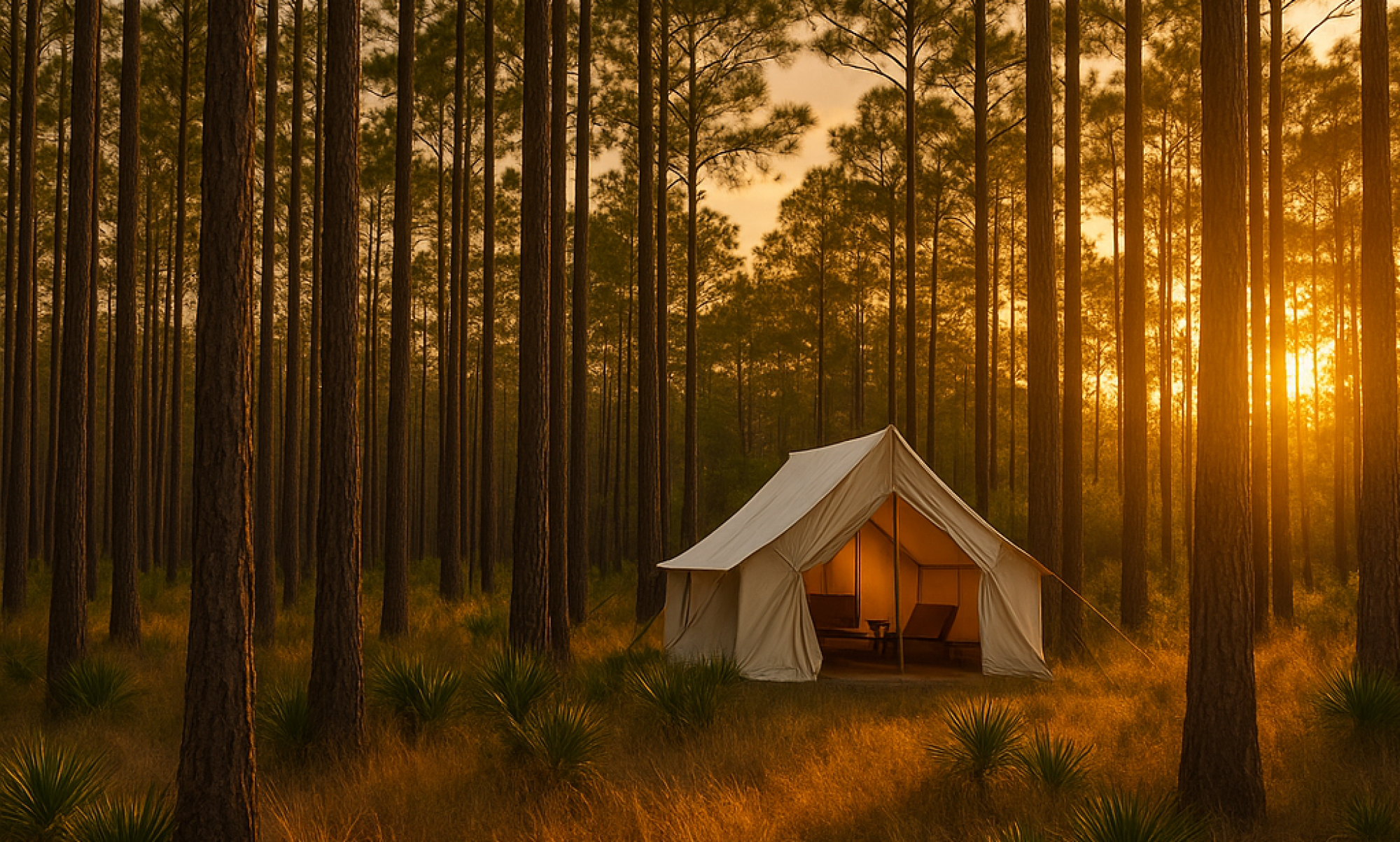
Today, Wes Skiles Peacock Springs State Park still feels surprisingly wild. It is not polished in the way some Florida state parks are. The roads are simple, the woods grow close, and the springs seem tucked into the landscape rather than built around.
There is something almost primordial about it.
And yet, on almost any visit, you are reminded that this quiet patch of North Florida is known far beyond North Florida. Cars in the parking area carry license plates from around the country. Sometimes you hear accents from other parts of the world.
They have come because beneath these woods lies one of the most extensive underwater cave systems in the country. But long before Peacock became a name known among cave divers, it was the name of a family.
Before the Divers Came
Dr. John Calvin Peacock came to this part of Florida from North Carolina in the years before the Civil War and settled near the springs that would eventually carry his family name.
The Peacock family built a life here. They farmed a large tract of land, raising cattle and growing crops, while Dr. Peacock practiced medicine throughout the surrounding countryside.
It is easy today to picture a doctor working from an office or hospital. In rural North Florida in the nineteenth century, the job looked very different. A country doctor might travel for miles by horse or buggy to reach someone who needed him.
The roads would have been rough. The communities were scattered. Much of the landscape between them was still forest.
Somewhere in those woods, the Peacocks built their home and raised their family. And eventually, they buried members of that family there.
The Cemetery
Not far from the springs is the Peacock family cemetery.
For many years, it became overgrown enough that it nearly disappeared back into the woods. Later, the cemetery was restored and marked, preserving one of the clearest physical connections between the family and the landscape that now carries their name. I like that the cemetery is still there.
The springs have become famous for something the Peacock family could never have imagined. Divers now travel thousands of miles to explore passages deep beneath their former land. Maps show miles of underwater cave extending beneath a landscape that, from above, still looks mostly like woods. But the family remains there too.
Their name appears on park signs, maps, cave surveys and dive logs.
Most people who say “Peacock Springs” probably never stop to wonder who Peacock was. For most of my life, I didn’t either.
A Name Can Outlive a Place
That has become one of the things I notice more often as I learn the stories of North Florida. Names survive. A ferry disappears, but Charles Spring remains. A preacher passes through a community, and generations later his name may still be attached to a spring.
A family settles beside a patch of woods in the nineteenth century, and people from around the world eventually travel there carrying dive tanks beneath a sign bearing their name.
The places change. The reasons people come to them change.
But sometimes the name stays.
I wonder what Dr. Peacock would think if he could stand near the spring today and watch divers preparing to disappear beneath the water.
He probably would not recognize much of what they were doing. But he would recognize the woods. And he would certainly recognize the name.
Experience It
One of the best ways to experience Peacock Springs is to walk the interpretive trail that follows the cave system beneath the ground.
From the surface, it looks like a walk through ordinary North Florida woods. But beneath your feet are miles of flooded passages twisting through the limestone. The trail helps connect the landscape you can see with the one you cannot. That changes the way you walk through the place.
The woods stop feeling like empty space between the springs. You begin to understand that there is another landscape directly below you, hidden beneath the roots and soil.
While you are there, look for the plaque honoring Sheck Exley, one of the pioneers of modern cave diving.
That plaque has a different meaning for me because Sheck was once one of my high school math teachers. At the time, I knew him as an eccentric and interesting teacher who liked to say, “It’s my way or the highway.” I knew he was involved in karate. I did not fully understand that he was also helping explore and map the underwater world beneath places like this.
That is a story for another Field Note. For now, walk the trail slowly.
Think about the Peacock family who lived here before the park existed. Think about the divers who later came to understand what was hidden below. Then look around at the same woods that have been here through all of it.
The Peacock family gave this place its name. Generations later, people like Sheck Exley helped us understand what was hiding beneath it.
And once you know both stories are there, the woods feel a little different.
— Dion, Anasa founder