
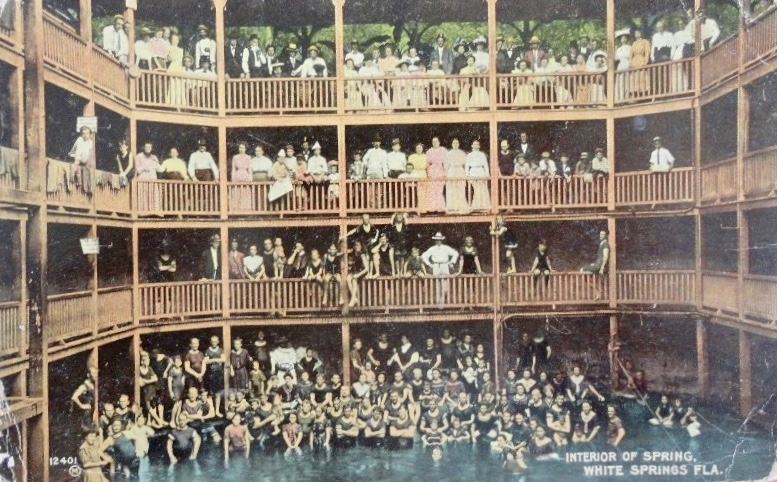
White Springs is a small town today. It was a small town then, too, at least by any national measure. But for a brief period around the turn of the twentieth century, it became something much larger than its population would suggest. The reason was the spring.
People came to White Springs to drink the mineral water, bathe in it, and seek relief from whatever ailments they believed the water might cure. They came by stagecoach and later by train. They stayed in hotels and boarding houses, ate in restaurants, shopped in town, and spent days or weeks beside the Suwannee.
The spring did not just give White Springs its name. For a time, it gave the town its economy. By 1910, White Springs had at least thirteen hotels and boarding houses. There were shops, entertainment, dining rooms, transportation services, and a growing resort economy built around visitors coming to take the waters. The town had 1,177 residents that year. Today, White Springs has fewer than 800.
That difference does not prove that the spring alone made or unmade the town. White Springs also had lumber, agriculture, railroads, and other industries that shaped its fortunes. Fire, changing travel patterns, highways, and the rise of other Florida destinations all played a part in what happened next.
Still, the numbers hint at just how much activity once revolved around the spring. At the center of it all was the spring house.
What survives today is a striking shell of what it once was. The old walls still rise beside the Suwannee, enclosing a place that once drew visitors from across the country. Historic photographs show crowds, bathing platforms, and an elaborate structure built around water that flowed with enough force to make the spring itself the centerpiece of town life. And that is where the story becomes harder to ignore. The spring barely flows now.
The first time you see the old spring house, it can be difficult to reconcile the ruins with the stories. You can understand the architecture. You can imagine the hotels. You can picture people arriving by train and walking toward the water. But then you look down. The thing that made all of this possible is barely there.
White Sulphur Spring once discharged large quantities of water from the Floridan aquifer. Over the twentieth century, that flow became weaker and less reliable. By 1977, the spring stopped flowing altogether for the first time on record.
The reasons are more complicated than any single explanation. Spring flow depends on pressure in the aquifer below us. Rainfall matters. Drought matters. So does groundwater pumping. And in White Springs, there is another part of the story just north of town.
The phosphate mine opened in the 1960s, and groundwater associated with its operations has long been pumped from the same regional aquifer system that feeds springs like White Sulphur. Later groundwater modeling found that phosphate pumping had a measurable effect on White Springs, and that removing that pumping in the model allowed spring flow to recover significantly.
That does not mean every gallon pumped by the mine would otherwise have come bubbling out of White Sulphur Spring. Groundwater does not work that neatly. But it does mean the connection is more than speculation.
Part of me wants the answer to be simple. Shut down the mine, let the aquifer recover, and see whether the spring that made White Springs famous could flow again. I would love to see that happen.
But I also grew up in this part of North Florida, and I know the other side of that equation. The phosphate industry has provided generations of jobs across Hamilton, Suwannee, and the surrounding counties. Members of my own family have worked there. So have the families of people I grew up with. For a rural community, those jobs are not an abstraction.
That does not make the loss of the spring less important. It does not mean groundwater impacts should be ignored. It simply means the question cannot honestly be considered in a vacuum. I can wish the spring flowed the way it once did and still understand why the answer is more complicated than simply closing the gates at the mine. That may be the part of White Springs’ story I find most interesting now.
The town was once built around a natural feature powerful enough to shape its economy, its identity, and the way outsiders saw it. The spring house still stands. The spring itself is barely a trickle.
The strangest thing about visiting the old spring house today is that the building outlived the water it was built around. And yet the story is not completely finished. White Springs is still here. So is the spring. The question now is what both of them become next.
Experience It
The old spring house sits beside the Suwannee River in White Springs, a short drive from Anasa and close to Stephen Foster Folk Culture Center State Park.
Walk down to the spring house and spend a little time there before heading toward the river. Look at the walls, the scale of the enclosure, and the old photographs .
Then look at the water that remains. It is one of the clearest places in North Florida to see how dramatically a landscape can change while the structures around it remain.
If you are staying at Anasa, White Springs makes an easy half-day outing and pairs naturally with a walk through Stephen Foster, a stop at the Telford Hotel, or a drive along the Suwannee. This is one of those places where the story becomes easier to understand once you stand inside it.