My dad took my sister and me to Telford Spring so often when we were kids that it almost felt like our backyard pool. I can still picture the old oak tree overlooking the spring, with my boombox propped against it playing cassette tapes filled with whatever 80s music I was into at the time.
My dad was not especially cautious about the water. I remember him teaching one of my cousins how to swim by throwing him into the cold spring and letting necessity handle the lesson. My cousin figured it out pretty quickly.
We always stayed there for hours. Long enough that the cold water would eventually get to us, and we would swim out into the Suwannee for a while just to warm up before getting back in the spring.
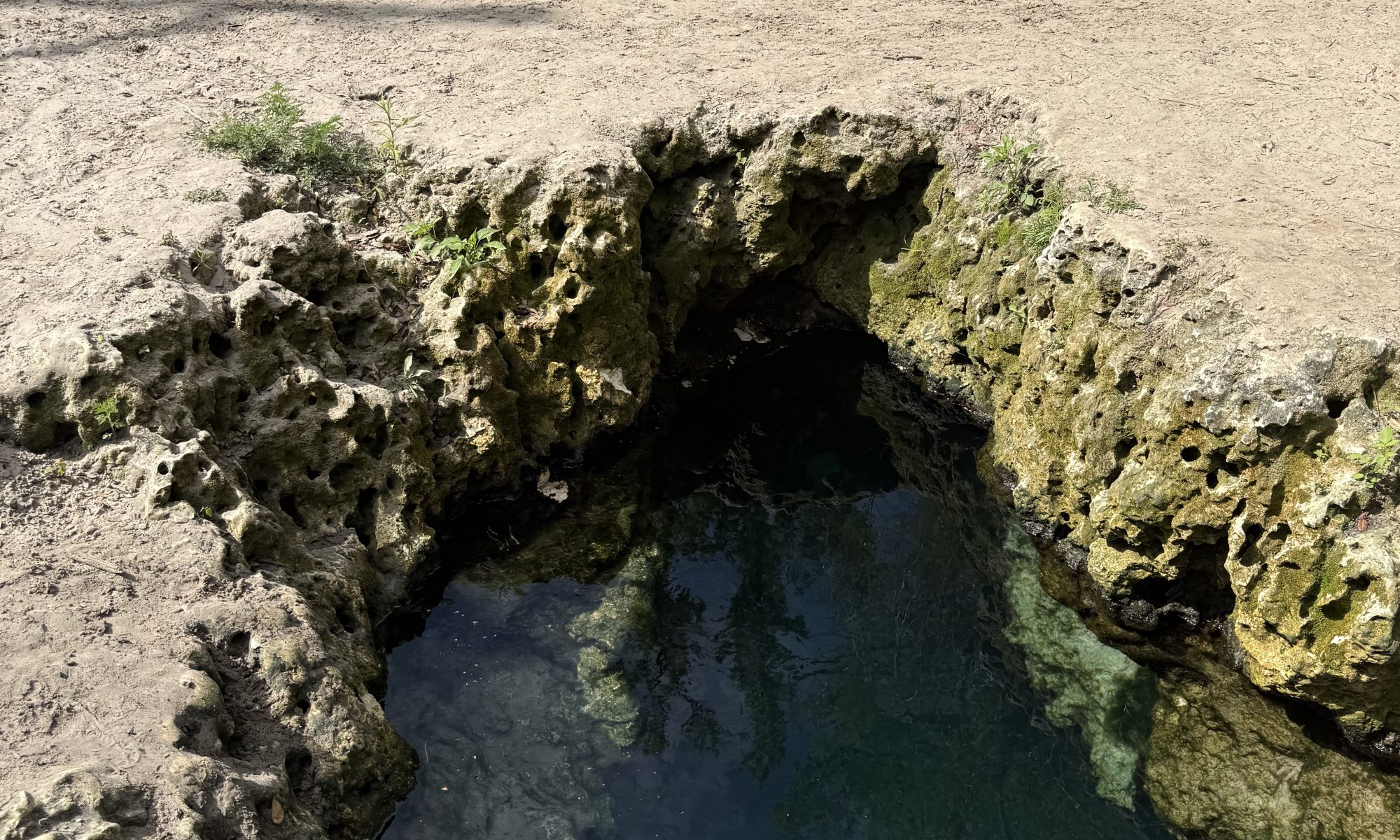
One of my favorite things to do was turn the spring into a challenge. I would dive in, swim through the cave beneath the limestone bridge, then keep going down the spring run toward the river, all underwater, just to see how far I could make it on one breath. At the time, I had no idea how much more water and limestone existed beyond what I could see.
For most of my childhood, Telford was simply a place we went. We swam, listened to music, and spent enough time there that it stopped feeling like somewhere we visited and started feeling like somewhere that belonged to us.
For all those years, though, I never really wondered who Telford was.
The Name Behind the Spring
The man behind the name was Reverend William Brazelton Telford, a Presbyterian minister who came to this part of North Florida around 1864, during the final years of the Civil War, and became associated with the Luraville area.
We know the spring came to bear his name. What is harder to recover is exactly why. Some accounts suggest he may have owned or homesteaded land in the area, but I have not found enough to say with confidence that the spring itself was part of his property. I have also found later memories of baptisms taking place at Telford, but nothing that proves Rev. Telford himself performed them there.
That uncertainty is part of what interests me. Perhaps the connection once seemed so obvious to the people living here that nobody thought it needed to be written down. More than 150 years later, the name has survived more clearly than the story behind it.
Sometimes history does not remain as a building or monument. Sometimes it survives because people keep saying a name.
The World Beneath Telford
As a kid, the little cave beneath the limestone bridge felt like the hidden part of Telford. It turns out I barely knew the beginning of it.
Beneath the spring is an underwater cave system extending far beyond the small passage we swam through. Cave divers spent years exploring and surveying those passages, eventually connecting Telford with other parts of the underground system beneath the surrounding landscape.
One of the people involved in that early exploration was Sheck Exley. That name means something different to me than it does to most people who know the history of cave diving. Sheck was one of my high school math teachers.
At the time, I knew him as an eccentric and interesting teacher who liked to say, “It’s my way or the highway.” I knew he was involved in karate. I did not understand the other life he was living beneath the waters of North Florida.
I would not learn until much later that he had helped explore places like Telford. By then, he had already been my teacher and had tragically passed away. I had known the teacher. I had known the spring. I simply had no idea, at the time, how closely those two parts of my world were connected. That is another story.
A Place Can Hold More Than One Life
The older I get, the more I realize that familiar places can hold stories we never knew were there. Telford was part of Rev. Telford’s North Florida. Later, it became part of Sheck Exley’s underwater world. And for me, it was part of childhood. The history does not replace any of those memories. It adds layers to them.
I can learn about the preacher whose name survived. I can look at maps of cave passages that extended far beyond anything I imagined as a kid. I can understand now that one of my teachers had explored beneath a place where I spent countless summer afternoons.
But when I picture Telford, that is still not what I see first. I see the oak tree. I hear cassette tapes playing from a boombox. I see my sister nearby and my dad at the spring.
Experience It
On one side of the limestone bridge is a small opening where I used to jump in the water. From there, you can swim through the short cave beneath the rock and emerge into the main spring. The water turns cold around you almost immediately.
Then look down the spring run toward the Suwannee, where the clear spring water meets the darker river. If you stay in the spring long enough, you may even understand why we sometimes climbed into the river just to warm up.
Before you leave, follow the trail back to the parking lot, walk to the left, and down into the nearby sinkhole. It connects into the larger Telford cave system, a reminder that what you see at the surface is only a small part of what is beneath you.
Then come back to the spring and sit beneath the oaks for a while. It is not a large place. It is not polished. It does not need to be.
Places become important for all kinds of reasons. Sometimes because of the history attached to them. Sometimes because of the people who explored them. And sometimes because someone you loved took you there again and again.
The water is still cold. The limestone is still there. And for me, so is my dad.
— Dion, Anasa founder