On opposite sides of the Suwannee River, two towns once faced each other. One sat on the east side of the Suwannee, near what is now Suwannee River State Park. The other grew across the river, near the meeting of the Suwannee and Withlacoochee. Columbus came first. Then Ellaville rose. For a time, both existed together. And eventually, both disappeared.
Today, if you drive through the area, you mostly see woods, river and old roads. It takes some imagination to understand that this quiet corner of North Florida once held two communities, each important in its own time.
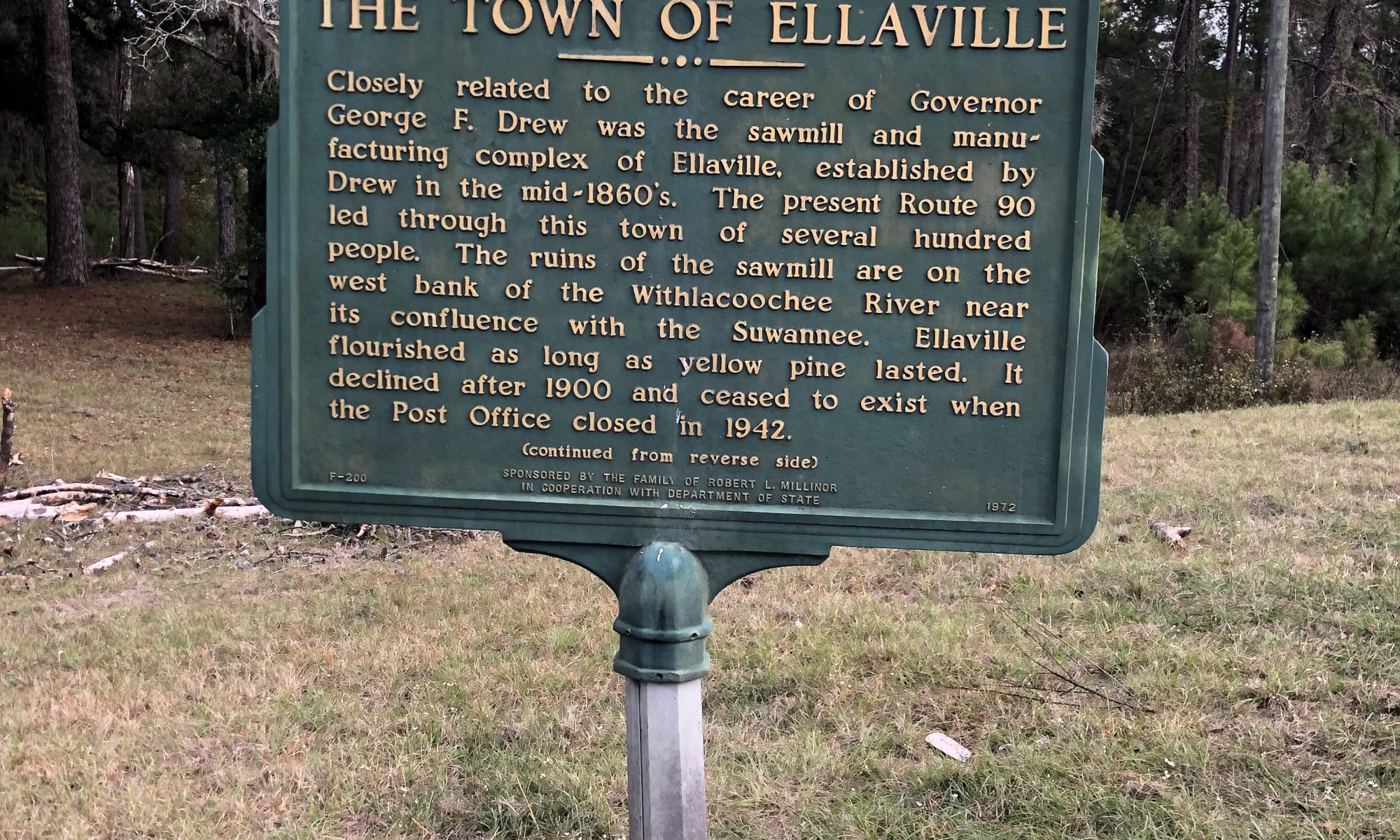
Years ago, when my son was still little, I took him out on the trails at Ellaville hoping we might find the ruins of George Drew’s mansion. We never made it that far. He had had enough walking, so we turned around. Now he is off at college, and I still remember how peaceful and beautiful those woods felt. A few years later, in 2019, I stopped and photographed the historical marker beside the road. In large letters, it says:
THE TOWN OF ELLAVILLE
Looking back at that picture now, what strikes me is how little of a town you can see behind it. There are trees, Spanish moss, grass and the familiar woods of North Florida. But Ellaville was not the first town here.
Before Ellaville, There Was Columbus
Columbus developed on the east side of the Suwannee in the early 1840s. Its location made sense because several different ways of moving through North Florida came together there. River traffic, ferries, stagecoach roads and mail routes all converged around the crossing, and later the railroad added another layer of importance.
Columbus became a place where cotton, goods, people and information moved through the region. Steamboats traveled the river. Stagecoaches connected the community with other settlements. A ferry carried people across the Suwannee.
By the Civil War, the railroad crossing was important enough that Confederate earthworks were built nearby to help defend it. For a while, Columbus seemed well positioned to last. Then a new town began growing across the river.
Ellaville Rises
After the Civil War, George Franklin Drew established a large sawmill and manufacturing operation on the opposite side of the Suwannee. North Florida was covered in yellow pine, and Drew built an economy around it. A town grew around the mill.
For several years, Columbus and the new settlement existed across the river from one another. One was an older transportation and river community. The other was a newer industrial town built around timber. Then the center of gravity began to shift.
In 1867, the Columbus post office was moved across the Suwannee to serve the growing sawmill complex, although it kept the Columbus name for a few more years. In 1872, the post office officially became Ellaville. By the early 1870s, Columbus had largely faded. Ellaville had taken its place.
George Drew built a substantial home there in 1868. Less than a decade later, he became governor of Florida. That detail helps me understand the scale of the place. Ellaville was not simply a small settlement beside a mill. For a time, it was one of the more important communities in this part of North Florida.
As Long as the Yellow Pine Lasted
Ellaville’s historical marker tells its story with an unusually simple sentence:
“Ellaville flourished as long as yellow pine lasted.”
There is almost an entire history of North Florida contained in those words. The forests that created Ellaville’s prosperity were also finite. As the surrounding timber was cut, the economic reason for the town began to disappear with it.
Ellaville declined after 1900. People left. Businesses closed. Houses vanished. The post office survived into the 1940s, but the town’s real boom had ended long before then. George Drew’s mansion remained standing after much of Ellaville had faded. Photographs from the twentieth century show the once-impressive house slowly deteriorating before it disappeared around 1970. The woods kept moving back in. Just as they had around Columbus before it.
What Stayed
Not everything disappeared. At Columbus, traces remain inside Suwannee River State Park: the cemetery, earthworks, old roads and places where people once approached the river. At Ellaville, the landscape is full of its own clues.
One of them is Suwanacoochee Spring. I remember paddling the Suwannee one day and passing the spring where its water enters the Withlacoochee. I was moving parallel to the shoreline when the outflow hit the side of my kayak hard enough that it nearly tipped me over.
That was my introduction to Suwanacoochee before I understood much about its connection to Ellaville. The walls around the spring are still there. The town is gone. The spring is not. Nearby, scattered ruins, old pathways and the landscape itself tell the same story in different ways. Once you know what was here, the empty spaces stop feeling quite so empty.
Two Towns, One River
What I find most interesting is how quickly the whole sequence happened. Columbus rose first, built around movement: ferries, stagecoaches, river commerce and later the railroad. Then Ellaville rose across the river, built around timber, manufacturing and transportation.
For a while, both towns existed at the same time. Then Columbus faded. A few decades later, Ellaville began fading too. Two towns rose along the same stretch of river, one after the other, and neither lasted very long.
The river stayed through all of it. The Suwannee and Withlacoochee kept flowing while one community rose, another replaced it, and eventually both disappeared back into the landscape.
That is one of the things I have come to love about exploring North Florida. Sometimes the most ordinary-looking woods are not ordinary at all. Sometimes they are the remains of one town. Sometimes two.
Experience It
This is a good place to explore as a pair. Start at Suwannee River State Park and look for the traces of Columbus: the cemetery, old roads and earthworks. As you walk, think about the stagecoaches, ferries and river traffic that once made this a crossroads.
Then walk across the old U.S. 90 bridge over the Suwannee into Ellaville. The bridge itself came much later than either town, but crossing the river on foot gives you a physical sense of just how close these two communities were.
On the Ellaville side, stop at the historical marker and walk the trails toward the Drew Mansion ruins. Find Suwanacoochee Spring near the meeting of the Suwannee and Withlacoochee and notice the walls still surrounding part of the water.
Neither place gives up its story immediately. That is part of what makes them worth visiting. You have to slow down, look carefully and imagine what is no longer there. Two towns once occupied this stretch of river. Now the river is what remains.
— Dion, Anasa founder