When the Stars Come Out

If you live in or near a city, you can go a long time without really seeing the night sky.

There are always lights somewhere. Streetlights line the roads, houses glow through the trees, parking lots stay illuminated long after dark, and the city itself throws enough light into the sky that many of the stars simply disappear from view.

Drive far enough into rural North Florida, though, and the night begins to look different.

Once the last light fades behind the trees and you get away from the glow of town, your eyes slowly begin to adjust. At first, you notice a few stars. Then a few more. Give it enough time, and the sky seems to keep filling in.

That experience always reminds me that darkness has become something many of us have to intentionally seek out.

For most of human history, a clear night meant looking up at thousands of stars. People used them to navigate, mark the seasons, tell stories, and make sense of the world around them. Today, many of us live beneath skies brightened by artificial light, and we rarely stop to think about how much has disappeared above us.

Of course, nothing has actually disappeared. We have simply made it harder to see.

A Different North Florida After Dark

We spend a lot of time talking about North Florida’s water, and for good reason. The springs and rivers are some of the most remarkable parts of this landscape.

But there is another side of North Florida that does not reveal itself until after sunset.

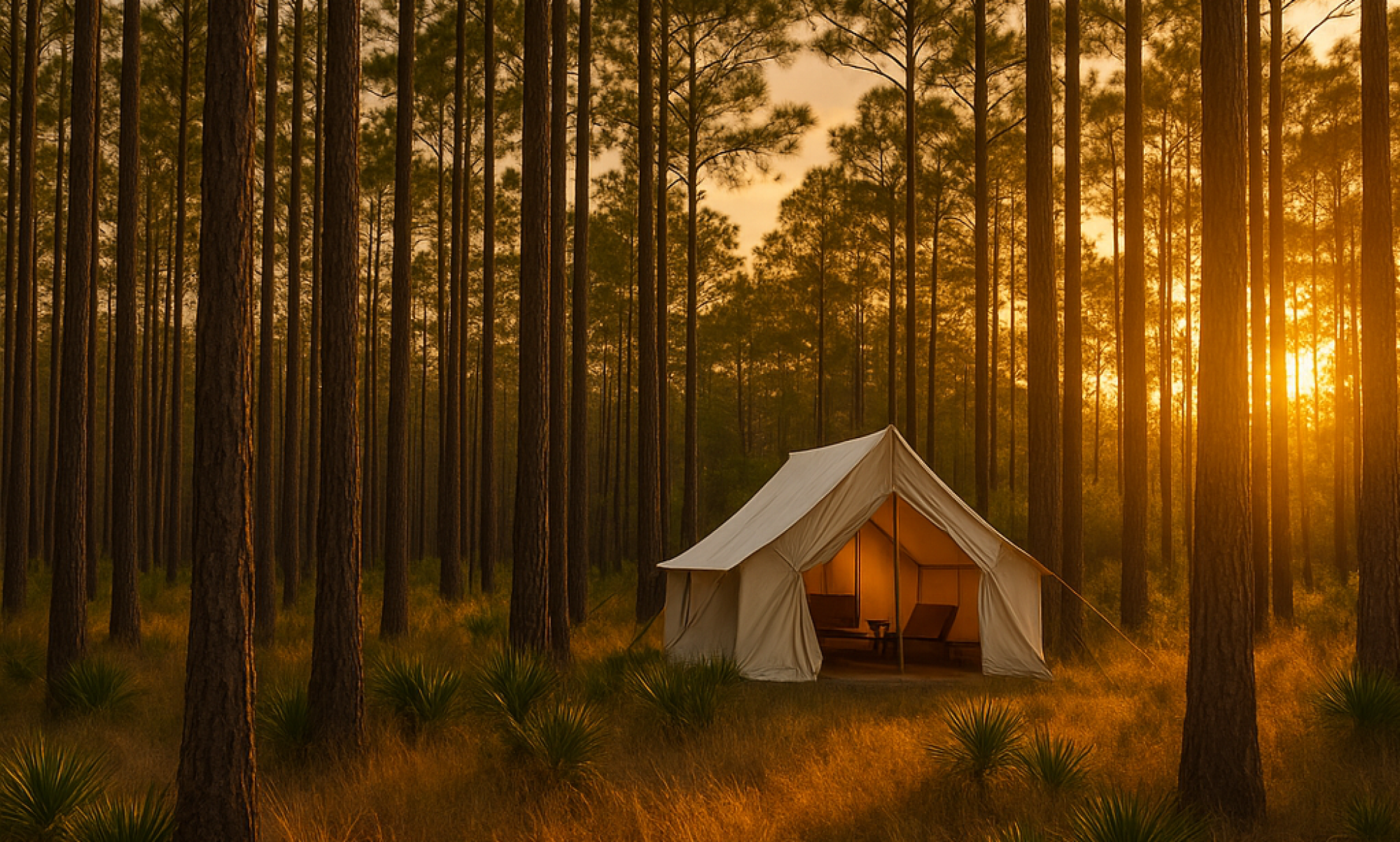
Once you get away from the larger towns and highways, there are still places where darkness feels like darkness. On a clear night, the number of stars can be startling if you are accustomed to a city sky. Under the right conditions, you may even be able to make out the hazy band of the Milky Way stretching overhead.

The experience is not only visual. The woods sound different after dark. Frogs and insects replace the daytime birds, an owl may call somewhere beyond the trees, and the breeze seems easier to notice when everything else settles down.

A place that felt familiar an hour earlier can feel completely different once the sun disappears.

There is something about sitting outside in that darkness that makes it easier to slow down. You can talk, listen to the fire, watch the sky, or simply sit quietly for a while without feeling like you need to move on to the next thing.

Sometimes that is enough.

Experience It

You do not need much to experience a dark North Florida sky. In fact, the less you bring with you, the better.

Find somewhere away from city lights on a clear night and give your eyes time to adjust. Put your phone away for a while, or at least turn the screen down. If you need a flashlight, use it sparingly. After twenty or thirty minutes in the darkness, you will begin noticing stars that were invisible when you first stepped outside.

You do not necessarily need to know what you are looking at, either. There are apps that can identify planets and constellations, and they can be useful, but sometimes I think we are too quick to turn every experience into something we need to understand or accomplish.

Sometimes it is enough simply to look up.

If you are near the Suwannee, spend some time beside the river after dark. If you are camping, let the fire burn down and see what begins to appear above you. If you are somewhere quiet enough to hear frogs, insects, and wind instead of traffic, stay outside a little longer than you normally would.

North Florida gives us plenty of reasons to explore during the day, but some of its best moments happen after we normally would have gone inside.

The stars have been there all along. Sometimes we just need to get somewhere dark enough to see them.

— Dion, Anasa founder
Baptizing Spring

I had driven past Baptizing Spring more times than I could count before I ever saw it.

It sits in an undeveloped part of Peacock Springs State Park, across the road from Peacock Springs and Orange Grove Sink. Those places are destinations, drawing people to swim, dive, and explore some of North Florida’s remarkable waters.

Baptizing Spring is different. The spring itself is small, especially by North Florida standards, and isn’t really suited for swimming. Even if it were easier to reach, it probably would never become the kind of spring people plan a day around.

What makes Baptizing Spring remarkable isn’t really the spring at all. It’s the stories hidden around, and beneath, it.

I first visited about five years ago after asking park management for permission to go back there. I knew the name, but I knew almost nothing about its history. I certainly didn’t realize that hidden in those woods was the site of a seventeenth-century Spanish mission and a Native community whose story began more than two hundred years before the Charles family established their ferry on the Suwannee.

In the early 1600s, Spanish Franciscan missionaries established San Juan de Guacara here among the Native people already living in this part of Florida. Archaeological excavations at Baptizing Spring have uncovered evidence of structures, hearths, storage areas, and other features of everyday life. This wasn’t simply a place where missionaries occasionally stopped. It was a community.

That discovery changed the way I thought about the history of this area. It’s easy to imagine North Florida’s story beginning with settlers, ferries, railroads, and the small towns we know today. In reality, people had been living, traveling, trading, and building communities across this landscape for centuries before Florida became an American territory.

San Juan de Guacara was part of the Spanish mission system that stretched across northern Florida. The missions brought Christianity, but they were also part of Spain’s colonial system, placing growing demands on the Native communities around them. Those tensions eventually contributed to the Timucua rebellion against Spanish authority in 1656, after which the mission at Baptizing Spring was abandoned and relocated west toward an important crossing of the Suwannee River.

That caught my attention because it takes us back to the subject of our last Field Note: Charles Spring.

More than 150 years before Reuben and Rebecca Charles established their ferry there, people had already recognized the importance of that same area as a crossing of the Suwannee. Long before Bellamy Road reached the river, this landscape was already connecting people.

There may even be a connection between San Juan de Guacara and the name Suwannee itself. The origin of the word isn’t settled, but one theory traces it to the Spanish San Juan. Historical maps show the river under that name and later variations before spellings resembling Suwannee began to appear. We may never know the answer with certainty, but the possibility adds another fascinating layer to the story of this otherwise unassuming place.

Baptizing Spring has another surprising connection, although this one is underground.

In 2010, cave divers connected Baptizing Spring to the extensive Peacock Springs cave system across the road. From the surface, the two places seem separate. Peacock is one of Florida’s best-known cave-diving destinations, while Baptizing Spring is a small spring hidden in undeveloped woods. Beneath the ground, however, they’re part of the same system.

I love that contrast because it captures Baptizing Spring perfectly. Almost everything interesting about this little spring is something you cannot see at first glance. Its water connects underground to Peacock Springs, its woods conceal the remains of a community that existed four centuries ago, and its history reaches west toward the Suwannee.

The spring may be small, but its connections are anything but.

Experience It

Baptizing Spring itself will probably never be a North Florida destination, and perhaps that’s fitting. It also isn’t a place I would encourage anyone to simply wander into. The spring lies in an undeveloped part of the state park, and when I visited, I first asked park management for permission. More importantly, it is an archaeological site worth protecting.

Fortunately, you don’t have to visit Baptizing Spring itself to experience the landscape that makes its story meaningful.

Visit Peacock Springs and Orange Grove Sink across the road. Walk beneath the oaks and pines, look at the limestone beneath your feet, and spend some time around the water. While you’re there, remember that the cave passages beneath you extend beyond the places you can see and connect to that little spring hidden in the woods nearby.

Then consider another connection you can’t see. More than four centuries ago, people were living and building a community in those same woods.

When I finally visited Baptizing Spring about five years ago, I thought I was simply seeing an obscure spring I had driven past for years. I know now that its obscurity is part of what makes it so interesting.

Some places are worth knowing about even if you never visit them. Baptizing Spring is one of those places.

– Dion, Anasa Founder

Charles Ferry

Some of my earliest memories of Charles Spring have nothing to do with history. 

When I was growing up, my dad used to take me there to fish for catfish. We’d climb out onto a large, flat limestone rock overlooking the Suwannee River, bait our hooks, and settle in for the afternoon. It was always quiet, and most days we had the place to ourselves.

To me, it was simply a good place to fish with my dad.

I never wondered why it was called Charles Spring. I didn’t know there had once been a Charles Ferry, or that the small cemetery tucked beneath the oaks belonged to the family whose name still lives on across this landscape. I certainly didn’t realize that this quiet bend in the river had once helped connect a young Florida.

When the United States acquired Florida in 1821, the new territorial government faced a practical challenge. St. Augustine remained the territory’s oldest and most established city, while Tallahassee had been chosen as the new capital because it sat roughly between the former capitals of East and West Florida. Connecting those communities became essential, so Congress authorized the construction of the Bellamy Road, the first federally funded road in Florida.

The road crossed the Suwannee River at Charles Ferry. That made this quiet stretch of river one of the most important gateways in the new territory.

Without a bridge, every traveler heading between St. Augustine and Tallahassee eventually reached the same obstacle. The road simply ended at the water, and if they wanted to continue their journey, they depended on the Charles family.

Recognizing both the need and the opportunity, Reuben and Rebecca Charles established a ferry, trading post, and inn here in 1824. For more than fifty years, they welcomed travelers arriving from both directions, helping them cross the Suwannee and continue on their way.

Imagine arriving after several days on horseback or by wagon. Your supplies are running low, your horse is tired, and the Suwannee stretches across your path with no bridge in sight. While you wait for the ferry, you refill your water at the spring, purchase provisions from the trading post, and exchange stories with other travelers who have reached the same crossing from the opposite direction. For a little while, everyone’s journey pauses here, not because they have reached where they intended to stop, but because they have reached the river. The ferry carried people across the Suwannee.

The Charles family helped keep Florida moving.

One story about the Charles family has always stayed with me. According to local tradition, Reuben and Rebecca maintained friendly relationships with the Native Americans who lived in this area during one of Florida’s most turbulent periods. It’s said they wore red scarves so they would be recognized and left unharmed.

Whether every detail can be proven or not, I appreciate that the story has survived. History isn’t preserved only in official records. Sometimes it’s preserved because a community continues telling it.

As Florida grew, new roads, railroads, and bridges gradually replaced many of the old crossings that had once been so important. Bellamy Road faded into history, and unlike Suwannee Springs, no bridge was ever built to replace Charles Ferry. The bustle disappeared, the river grew quiet again, and the buildings eventually vanished.

But the name remained. It lives on today in Charles Spring, Charles Ferry, and the Charles family cemetery, quietly reminding visitors that the people who once helped connect a young Florida have never completely disappeared.

Experience It

Charles Spring isn’t a place to rush through.

Park in the spring parking lot and walk out to the Bellamy Road historical marker and follow the old road toward the river. As you walk beneath the live oaks, imagine wagons making the same approach almost two centuries ago, knowing their journey could not continue until they found a way across the Suwannee.

Then continue to the river, where public boat ramps now serve both banks. The ferry is gone, but people still begin journeys from this very crossing. Fishermen launch before sunrise, families paddle the river, and kayakers drift past the same shoreline where travelers once waited for their turn to cross.

Spend a few minutes at Charles Spring, where fresh water made this a natural stopping place long before automobiles existed. 

Before you leave, take the short walk to the Charles family cemetery. Read the names. Read the dates. Then take one last look toward the river. The crossing is still here. The spring is still here. The family name is still here.

The next time I visit Charles Spring, I’ll probably walk back out onto that same limestone rock where my dad and I used to fish. The river hasn’t changed much since those afternoons, but I have. Now, when I look across the water, I won’t just see one of my favorite childhood fishing spots.

I’ll see one of the crossings that helped shape a young Florida, and I’ll remember the family that helped keep it moving.

— Dion

Crossing the Suwannee

Every time I cross the Suwannee River, I do the same thing.

It usually starts with the highway signs. If you’ve driven across the Suwannee in Florida, you’ve probably noticed them, the signs with musical notes, a nod to the song that made this river famous.

And almost without fail, I start singing: Way down upon the Suwannee River… I’ve done it for years.

But more recently I found myself wondering something I’d somehow never really thought about: How did people get across before there were bridges?

It occurred to me that I’d crossed the Suwannee hundreds of times. I knew the song. I knew the river. I’d even jumped off one of its bridges.

But I’d never really thought about the crossing itself. 

Once you look at a map, the importance of the Suwannee becomes obvious. The river begins in Georgia and winds south through North Florida before emptying into the Gulf. Travel west across this part of Florida and, sooner or later, you have to cross it. To truly go around it, you’d have to head north into Georgia before coming back down into Florida.

Today, crossing hardly qualifies as an obstacle. We drive across a bridge in less than a minute. But for much of Florida’s history, it was a very different problem. Travelers had to find a crossing. And at Suwannee Springs, you can still see how four generations of Floridians solved it.

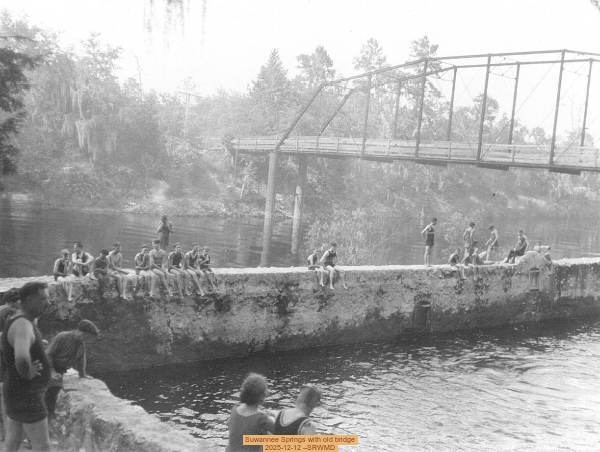
The earliest crossing at Suwannee Springs was a ferry. Before bridges connected the two banks, travelers arriving here had to stop and wait to be carried across. Eventually, the ferry was replaced by a bridge. That bridge was replaced by another. And that one eventually gave way to the modern crossing we use today.

Four generations of crossings, all within the same small stretch of river. Pieces of that history are still there. Near the spring, old rusted piers stand by the river, the remains of the first bridge that once carried travelers from one bank to the other.

Just downstream stands its successor, an old steel truss bridge that no longer carries traffic. Most locals know it simply as the Graffiti Bridge. And I knew that bridge long before I knew its history. When I was a teenager, the Graffiti Bridge was a popular swimming spot. And yes, we jumped off it into the Suwannee. More than once.

I’m certainly not recommending anyone repeat that particular part of the experience today. But whenever someone asks that old parental question, “If your friends jumped off a bridge, would you?” I suppose I have to answer honestly. Yes!

At the time, I wasn’t thinking about the bridge as history. It was simply part of growing up around the Suwannee. I didn’t know that another bridge had stood before it. I certainly wasn’t thinking about the ferry that came before either of them. It was just the river.

And maybe that’s what I find most interesting about these places. Sometimes we can know somewhere our entire lives without really knowing its story.

Think about how differently people have experienced this one spot.

There was a time when a traveler arrived at the Suwannee and had to stop. Was the ferry running? Was the river too high? How long would the crossing take?

Eventually, travelers crossed on a bridge. Years later, teenagers like me jumped from another one into the water below.

Today, most of us pass over the same river on a modern highway without giving the crossing much thought at all. The river is still there. The problem hasn’t changed. Every generation has simply found a different way across.

Experience It

The next time you’re near Suwannee Springs, don’t just cross the river. Stop for a while. Walk down to the spring and look out across the Suwannee. Imagine arriving here before there was a bridge and realizing that your journey couldn’t continue until someone carried you to the other side.

Look for the old bridge piers by the river. Then walk over to the Graffiti Bridge and stand on a crossing that itself became obsolete when the next generation built another one nearby. But please don’t follow my teenage example and jump off it!

Instead, take a few minutes to notice something that’s easy to miss: In one small stretch of the Suwannee, you can see the story of how North Florida learned to cross a river. And when you get back in the car and drive across the newest bridge, maybe do what I do. Sing a few words.

Way down upon the Suwannee River…

Only now, look down. And think about all the people who had to figure out how to get to the other side.

— Dion

Maybe she was paying attention all along

A few days ago, I was walking into a doctor’s appointment when my phone buzzed.

It was my daughter, Kendall. She’s in her first semester at FSU (Go Noles!) and she wanted to share something she workshopped in class.

I’ll admit it, I found myself wiping away tears in the hallway. Not because it was my daughter who wrote it, although I’m certainly a proud dad. But because every now and then someone puts words to something you’ve carried in your heart for a long time, and that’s exactly what she did.

As parents, we spend years hoping we’ve passed along something worthwhile. Kindness. Curiosity. A love of people and places. The ability to notice things others walk past.

Reading her poem, I realized something.

Maybe she was paying attention all along.

She gave me permission to share it, and I’m grateful she did. I hope it resonates with you the way it did with me.

Springs on the Suwannee

by Kendall Sweat

Somewhere

I sit among the bald cypresses and swamp gums

with my feet dipped in the cold, clear water,

anchoring me to the moment,

allowing me to stretch my own roots into the soil.

The water bugs dance past me

gliding like figure skaters across the surface,

whispering to me stay afloat

and trust the unseen.

The sun places a blanket over my soul,

encouraging me to curl up

among the bald cypresses and swamp gums

and let my body rest.

I melt into the land that I lie on:

my limbs become the trees,

my blood transforms to water,

my soul joins the dancing water bugs.

I am distant from civilization,

distant from the screaming cars

and the imposing skyscrapers;

the gray, dead concrete.

Somewhere

I sit among the bald cypresses and swamp gums

and their roots reach out to mine,

announcing where I belong.

The Rivers That Disappear

A few weeks ago, I wrote about the Cody Scarp. Millions of years ago, it was Florida’s coastline. Today, in many places, it’s little more than a subtle change in elevation. If you didn’t know it was there, you could drive across it without ever noticing.

But the more I learn about North Florida, the more I realize just how many of the things I love about this place trace back to that ancient shoreline. The springs. The sinkholes. The caves. Even the rivers.

Most rivers have somewhere to go. They flow into another river. A lake. Eventually, the sea.

But in North Florida, rivers begin doing something unusual when they reach the Cody Scarp. Some disappear.

The Santa Fe River flows normally until it reaches a place called River Sink. There, an entire river vanishes underground. Several miles later, it returns at River Rise and continues on toward the Suwannee.

Farther north, the Alapaha River reaches Dead River Sink. During periods of low water, so much water disappears into the limestone that long stretches of the riverbed can become dry.

The Aucilla River may be stranger still. It disappears underground and returns again and again, as if the river can’t decide whether it belongs above the ground or below it.

But not every river disappears. The Withlacoochee crosses the Cody Scarp too. Instead of vanishing, it becomes a river transformed by springs. Madison Blue Spring pours millions of gallons of groundwater into the river each day, and farther downstream, even more springs join it.

That’s what fascinates me. The Cody Scarp doesn’t make every river behave the same way. It simply changes the rules. Some rivers lose water. Some gain water. Some disappear. Some emerge. All because the limestone beneath them becomes exposed enough for water to move in ways it can’t farther north.

The river that has captured my attention is Little River, which is honestly more creek than river. It’s close to where I grew up. Little River flows quietly through North Florida until it reaches a landscape of sinkholes where the water disappears into the limestone.

What happens after that isn’t entirely understood. Researchers believe some of the water may return at Little River Spring, about ten miles away. Other research shows that water entering the Little River and nearby Stick Sink system contributes to the groundwater feeding Troy Spring, on the opposite side of the Suwannee River.

Think about that for a moment. A river disappears into the ground. Its water travels through limestone beneath forests, farms, roads, and even beneath the Suwannee River itself before returning to the surface.

Years ago, when looking for a home to build Anasa,  I nearly bought land just south of Little River Sink. The property had two sinkholes (or karst windows) where you could look directly into the underground water below.

What caught my attention was where they were. On a map, they appeared almost perfectly aligned between Little River Sink and Little River Spring. I have no idea whether they were actually connected. Maybe it was coincidence. Maybe it wasn’t. But standing beside those openings, it was impossible not to wonder what was happening beneath my feet.

That’s one of the things I love most about North Florida. The landscape doesn’t tell all of its stories on the surface. Sometimes they’re hidden beneath the limestone. Sometimes they’re carried underground by rivers that disappear. Sometimes they’re revealed again where a spring quietly returns them to daylight. You just have to pay attention.

Because the North Florida we see is only half the story. Beneath it is another landscape entirely. One where rivers don’t always follow the blue lines we draw on maps.

— Dion

P.S. Have you ever visited River Sink, Dead River Sink, Madison Blue, Little River, or Troy Spring? I’d love to hear which North Florida places have surprised you the most.

The Railroads That Disappeared

I grew up around the remains of railroads I never really knew were there.

When I was a child, an old steam locomotive sat beside the Luraville Country Store. I knew it had been pulled from the Suwannee River. I knew it was old. But I don’t think I understood just how old it was, or what it represented.

The locomotive was already an antique when it arrived in Suwannee County. Historians believe it was built sometime between 1850 and 1855, making it one of the oldest surviving steam locomotives in the country. It may have pulled passenger cars during its early years, before being sold to the Bache Brothers Lumber Company around 1890 and put to work hauling logs through the forests of North Florida.

Around 1900, its working life ended in the Suwannee River. No one knows for certain exactly how it happened. One story says the locomotive jumped the tracks at a curve and fell into the river. According to local accounts, the locomotive was being moved across the Suwannee by barge to reach timberland in Lafayette County. As it was lowered down the bluff on a temporary track, the restraining lines broke. The locomotive rolled across the barge and disappeared into the river.

It stayed there for 81 years. During periods of low water, people could see parts of the locomotive beneath the surface of the river. It became part of the local landscape and part of the stories people told.

In 1976, a group tried to recover it. They removed the bell, whistle, throttle, and other pieces, but they couldn’t bring up the locomotive.

Somewhere in this history is a story my uncle Larry once told me. Uncle Larry said he had been involved in an attempt to pull the locomotive from the Suwannee with a wrecker. As I remember him telling it, they weren’t successful. I haven’t been able to determine exactly when his attempt took place or whether it was part of one of the documented recovery efforts. But I remember the story.

And on January 19, 1979, James “Buddy” Lancaster finally brought the locomotive back to the surface. Lancaster had grown up seeing the locomotive in the river during periods of low water and dreamed of recovering it.

After 81 years underwater, the old engine was pulled across the river bottom and brought ashore on the Suwannee County side.

Lancaster brought it home to Luraville and displayed it beside the Luraville Country Store, which his family owned and operated.

That’s where I remember seeing it. I was a child then.

I knew the locomotive had come from the river. But I didn’t understand that the rusting engine beside the road had been built before the Civil War, may once have carried passengers, later hauled logs through the forests of North Florida, and spent more years underwater than most people live.

Eventually, the locomotive was sold to Jack Goyke of Jacksonville Crane Company, who donated it to the State of Florida in 1982. It was restored and moved to Tallahassee, where it remains today.

But the locomotive isn’t the only reminder of the railroads that once crossed this part of Florida. Not far from my river property, another one is still standing in the Suwannee. It’s called Drew Bridge.

Today, the bridge is one of the strangest things you’ll see along this stretch of river. On one side, a dirt road comes relatively close. On the other side, there is almost nothing but forest. No highway. No town. No obvious reason for a bridge to be standing there at all.

But more than a century ago, trains crossed the Suwannee here. According to local histories, the swing bridge was purchased in Brazil around 1899, transported to the Suwannee River, and placed into service around the beginning of the twentieth century.

It became part of the Suwannee & San Pedro Railroad, a line that ran from Live Oak through Mayo and eventually toward Perry. The railroad wasn’t simply carrying passengers between towns. It was part of a much larger network built to reach the forests.

Across Florida, logging companies pushed railroads deeper into timber country. The trains carried workers, equipment, and logs. Communities grew along the tracks. Some of those logging railroads eventually helped lay the foundation for larger commercial lines.

At Drew Bridge, the railroad created its own path through the forest. Tracks approached the river. Trains crossed the swing bridge. The railroad continued through what is now thick woods.

Then the railroad disappeared. The tracks were removed. The forest grew back.

Around 1920, Suwannee and Lafayette counties purchased the abandoned bridge with hopes of converting it into a road crossing. That never happened. The roads never came. And the bridge stayed.

I’ve known about the locomotive and Drew Bridge for most of my life. I saw the locomotive beside the Luraville Country Store. My uncle told me about trying to pull it from the river. I’ve passed the old bridge many times by kayak.

But for most of my life, they were separate curiosities. An old locomotive. An abandoned bridge. Stories people told. Only recently have I begun to understand that they are remnants of something much larger.

There was once an extensive network of railroads crossing this part of Florida. Some carried passengers and freight between towns. Others were built deep into the forests to carry away the longleaf pine and cypress that fueled the growth of North Florida.

The locomotives disappeared. The tracks were pulled up. The mills closed. The forest grew back. And within only a few generations, much of that railroad world became almost invisible.

That’s one of the things I find most interesting about North Florida. The landscape doesn’t always tell you what happened there. Sometimes you have to look for what’s left behind.

A locomotive pulled from the bottom of a river. A bridge standing in the middle of the Suwannee. A faint railroad grade disappearing into the forest.

Pieces of a world that once connected towns, carried timber, moved people, and helped shape this part of Florida. The railroad is gone. But if you know where to look, you can still find the tracks it left behind.

— Dion

The Forgotten Resort on the Suwannee

There was a time when people traveled from all over the country to visit Suwannee Springs. Today, most people drive right past it without realizing it’s there.

The springs sit beneath a canopy of oaks along the Suwannee River, tucked away at the end of a quiet road. If you visit today, you’ll find the remains of stone spring walls, a few scattered ruins, and the river flowing much as it always has.

The spring itself is a sulfur spring. You’ll notice the smell almost immediately. It’s not unpleasant once you know what it is, but it’s certainly distinctive. More than a century ago, that mineral-rich water was the attraction. People believed the spring’s waters could help heal a variety of ailments, and they traveled hundreds of miles by train to experience them.

It’s hard to imagine now, but this was once one of Florida’s earliest tourist destinations. Over the years, grand resort hotels were built here to serve visitors who came seeking the mineral waters flowing from the springs. One after another, those resorts were destroyed by fire, leaving behind little evidence of what once stood here. The grounds are quiet. The river moves slowly past the springs. The oaks cast shade over ruins that many people never notice.

For most of my life, I didn’t think much about any of that. To me, Suwannee Springs was a place to swim. My favorite place to jump was from the far spring wall. To get there, I would walk along the top of the old spring structure, all the way around to the opposite wall. The jump felt a little higher there. The water felt a little deeper. Whether it actually was or not didn’t matter much. To me, it was the best place to jump.

I spent years visiting the springs without giving much thought to the people who came before me. Now when I stand there, I find myself looking at those same walls differently.

The wall I once jumped from was built during a time when visitors traveled hundreds of miles to experience these springs. And it’s strange to think that a place many Floridians have never heard of was once known well beyond North Florida.

I’ve always been fascinated by places like that. Not because of what they are today, but because of what they used to be. You can stand beside the spring walls and try to picture the people who once gathered there. Families arriving after long journeys. Visitors hoping the spring waters would improve their health. Guests walking the grounds of hotels that no longer exist. A bustling destination where today there is mostly quiet. What I find most interesting is how little remains.

Many of Florida’s historic attractions were replaced, redeveloped, or built over.

Suwannee Springs feels different. Nature has slowly reclaimed much of it. The river still flows past the springs. The oaks still shade the grounds. And if you look closely, you can still find traces of the people who believed this place was worth traveling hundreds of miles by train to see.

That’s one of the things I love about North Florida. It holds onto its stories. Not always in museums or history books. Sometimes they’re tucked away beside a river, waiting for someone curious enough to stop and look.

— Dion

P.S. Have you ever visited Suwannee Springs? I’d love to hear what you remember about it.

The Coastline That Disappeared

FIELD NOTES FROM NORTH FLORIDA

One of the most important features in North Florida is something most people never even notice. In fact, if you didn’t know it was there, you could drive past it a hundred times and never give it a second thought. Just like I did. 

Millions of years ago, it was Florida’s coastline. Today, geologists call it the Cody Scarp. 

The funny thing is that it isn’t especially dramatic. It’s not the Grand Canyon. It’s not a mountain range. In many places, it’s little more than a subtle change in elevation. But it may be the reason North Florida became such a unique landscape.

The first clue is that you can find shark teeth in the Suwannee River. Not at the beach. Not along the coast. In a river winding through pine forests and cypress swamps, miles and miles before it reaches the Gulf.

Long before there were springs, farms, roads, or even the Suwannee River itself, the sea reached much farther inland than it does today. The Cody Scarp marks one of those ancient shorelines.

North of that ancient shoreline, water tends to stay on the surface. South of it, water disappears into the limestone beneath your feet.

That’s where things start to get interesting. North of here, the Alapaha River can disappear entirely into the ground at a place called Dead River Sink. The river simply vanishes into the limestone.

Elsewhere, that same underground world sends water back to the surface, creating the springs that have drawn me back again and again throughout my life. Peacock. Telford. Madison Blue. Troy. And dozens more.

I spent years swimming in these springs before I understood why they were here at all. In many ways, the Florida I grew up loving exists because of a coastline that no longer exists.

The more time I spend exploring this part of Florida, the more I realize that many of the things I love about it trace back to this ancient shoreline. The springs. The sinkholes. The disappearing rivers. Even the shark teeth hidden in the Suwannee.

That’s one reason I love North Florida. It doesn’t reveal itself all at once. The beaches announce themselves. The theme parks advertise themselves. But North Florida asks you to pay attention.

And if you do, you’ll discover rivers that disappear, springs that emerge from nowhere, and traces of an ocean that vanished millions of years ago.

— Dion

P.S. Have you ever found a shark tooth in a river or creek? I’d love to hear where.

I Thought There Would Be Resorts Here

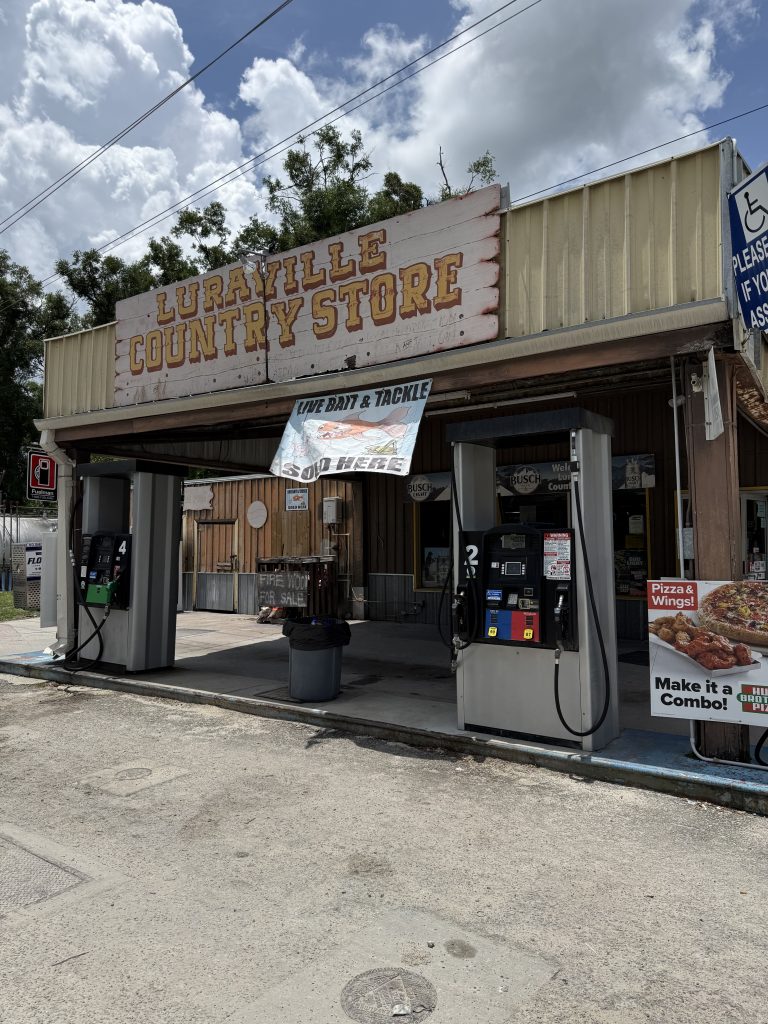
Luraville Country Store

As a kid, I was convinced this road would someday be lined with resorts.

If you’ve ever been to the springs along the Suwannee River, you might know the turn I’m talking about. You leave Highway 51 at the flashing light by the Luraville Country Store and turn left.

Even then, it felt like you were going somewhere special. I just assumed everyone else would eventually figure it out too. I imagined traffic. Hotels. Restaurants. Souvenir shops. Surely the rest of the world would discover what we already knew.

Instead, that road has barely changed in my lifetime. It’s still one of the quietest roads I know. And I’m glad.

The first spring along that road for me was Telford Spring.

I spent so many summer days there with my dad that I almost think of it as my home spring. It’s not the biggest spring in Florida. It never has been. But it has always felt special.

There’s a small spring basin, crystal-clear water, and a short cave you can swim through. Growing up, it was mostly a local spot. The kind of place where you recognized the other cars parked nearby.

At one point it was closed off and could only be reached by boat. Today it’s once again open to the public thanks to the water management district, and people still love it.

When I think about Telford, I don’t just remember the spring itself. I remember sitting beneath an old oak tree with my boom box propped against the trunk, 80s music playing while I swam in water so cold it almost hurt when you first jumped in. Those memories feel as clear as the water.

A little farther down the road is Peacock Spring.

Long before it became a state park, it was simply a dirt road disappearing into the woods. It still feels that way.

Peacock has a primordial quality to it. Even now, it feels more like a discovery than a destination. You won’t usually find crowds there. Instead, you’re likely to meet people who have traveled from around the world to dive one of the most remarkable underwater cave systems on earth.

One of my favorite memories is riding on the back of my dad’s green MGB convertible with my sister while he flew down that old bumpy dirt road. To us, it felt like a roller coaster.

Even today, Peacock can feel like it’s yours alone. Sometimes the only sign that anyone else is there, besides a few cars in the parking lot, is a stream of bubbles rising from deep below the surface, evidence of cave divers exploring the darkness beneath your feet.

Inside the park is Orange Grove Sink.

Most days, the surface is covered in duckweed, tiny flowering plants that create what looks like a solid green carpet across the water. But if divers are below, their bubbles often clear patches in the surface, revealing the clear water underneath.

One side of the sink is bordered by a towering limestone cliff. As teenagers, after hot days working in the tobacco fields, my friends and I would gather there and leap from the rocks, trying flips and tricks that seemed like a great idea at the time. I’m not sure I’d recommend all of our decisions. But I’d relive those summers in a heartbeat.

When I was young, I thought this road would become famous. I thought resorts would appear. I thought crowds would follow. Instead, it stayed mostly the same.

And maybe that’s the reason these places still feel so special.

— Dion

PS. The summer is a great time to visit North Florida.