
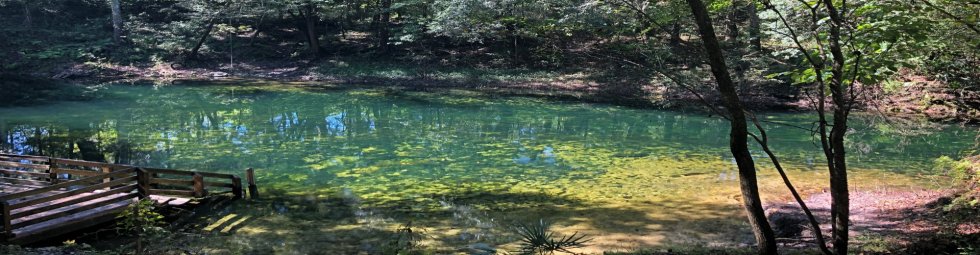
There is a place just off Highway 90 west of Live Oak where a river seems to appear out of nowhere. For a few hundred feet, water moves through a wooded opening in the limestone. Then, almost as quickly as it appeared, it disappears again.
Falmouth Spring has sometimes been called the shortest river in the world. It is a great nickname, although it is not really accurate. The truth may be more interesting.
Falmouth is what geologists call a karst window, a place where the roof above an underground waterway has collapsed and exposed part of the Floridan aquifer to the surface. The Suwannee River Water Management District says the visible run extends for about 450 feet before the water disappears underground again.
So what looks like the beginning and end of a tiny river is really neither. We are simply seeing part of a much longer journey.
I grew up in this part of North Florida, and like so many places I have written about in Field Notes, Falmouth was close enough to feel ordinary. Highway 90 is not some remote wilderness road. It is one of those roads many of us have driven countless times without thinking much about what might be underneath it.
And there is quite a lot underneath it. North Florida is built on limestone. Water works its way through cracks and openings in that limestone, gradually creating caves, passages, sinks, and springs. Rivers disappear. Springs emerge. Water that vanishes in one place may show up miles away somewhere else.
Falmouth gives us a rare chance to look directly into that hidden landscape. Years ago, scientists and cave divers suspected that the underground water at Falmouth was connected to springs farther west near the Suwannee River. The Florida Geological Survey and Suwannee River Water Management District eventually used dye tracing to investigate those connections. Their work demonstrated underground links through the broader Falmouth-Ellaville-Suwannacoochee system.
That immediately caught my attention because Ellaville is another place I have already written about. Above ground, Falmouth and Ellaville seem like separate places. One sits beside Highway 90. The other is several miles away at the meeting of the Suwannee and Withlacoochee Rivers, where the remains of a once-busy town have largely disappeared back into the woods.
Underground, the landscape does not respect those boundaries. Water connects them. There is an even deeper layer to the story.
Not far from Falmouth is Cathedral Cave, part of the same enormous underground system. Cave divers have explored passages beneath this landscape for decades, and once again I found the name of someone I knew before I understood why his name kept appearing beneath North Florida, Sheck Exley.
I have written before about Sheck being one of my high school math teachers and about how I only learned years later that he had been one of the most accomplished cave explorers in the world. His exploration included the Cathedral system near Falmouth, where divers encountered enormous underwater passages extending through the limestone beneath farms, roads, and woods.
Once again, I found myself thinking about how strange it was that these two versions of North Florida had existed around me at the same time. There was the North Florida I could see: highways, pine trees, farms, rivers, springs, and little towns. Then there was another North Florida underneath it.
In that landscape, rivers travel through darkness. Caverns stretch beneath roads and property lines. Water disappears into the ground in one place and emerges somewhere else miles away. Most of us spend our entire lives walking and driving across that second landscape without ever seeing it.
Falmouth is different because, for a few hundred feet, the hidden world comes into the light. That is why I think calling it the shortest river in the world almost sells the place short.
The 450 feet of water we can see may actually be the least remarkable part of its journey. The water did not begin there, and it does not end there. We just happen to be standing at one of the places where North Florida briefly lets us see what is happening underneath.
Experience It
Falmouth Spring sits just off U.S. Highway 90 west of Live Oak and is managed by the Suwannee River Water Management District. The property is open for activities including hiking, picnicking, wildlife viewing, and swimming.
From Anasa, Falmouth makes an easy outing and can be paired particularly well with Suwannee River State Park and the old townsite of Ellaville.
Visit Falmouth first and watch the water disappear underground. Then head west toward Ellaville and the Suwannee. The two places may look unrelated from the road. Underneath your feet, they are part of the same story.
Falmouth may not really be the shortest river in the world. It may be something more interesting. It is a window into the river we cannot see.
— Dion, Anasa founder