The Towns That Disappeared

On opposite sides of the Suwannee River, two towns once faced each other. One sat on the east side of the Suwannee, near what is now Suwannee River State Park. The other grew across the river, near the meeting of the Suwannee and Withlacoochee. Columbus came first. Then Ellaville rose. For a time, both existed together. And eventually, both disappeared.

Today, if you drive through the area, you mostly see woods, river and old roads. It takes some imagination to understand that this quiet corner of North Florida once held two communities, each important in its own time.

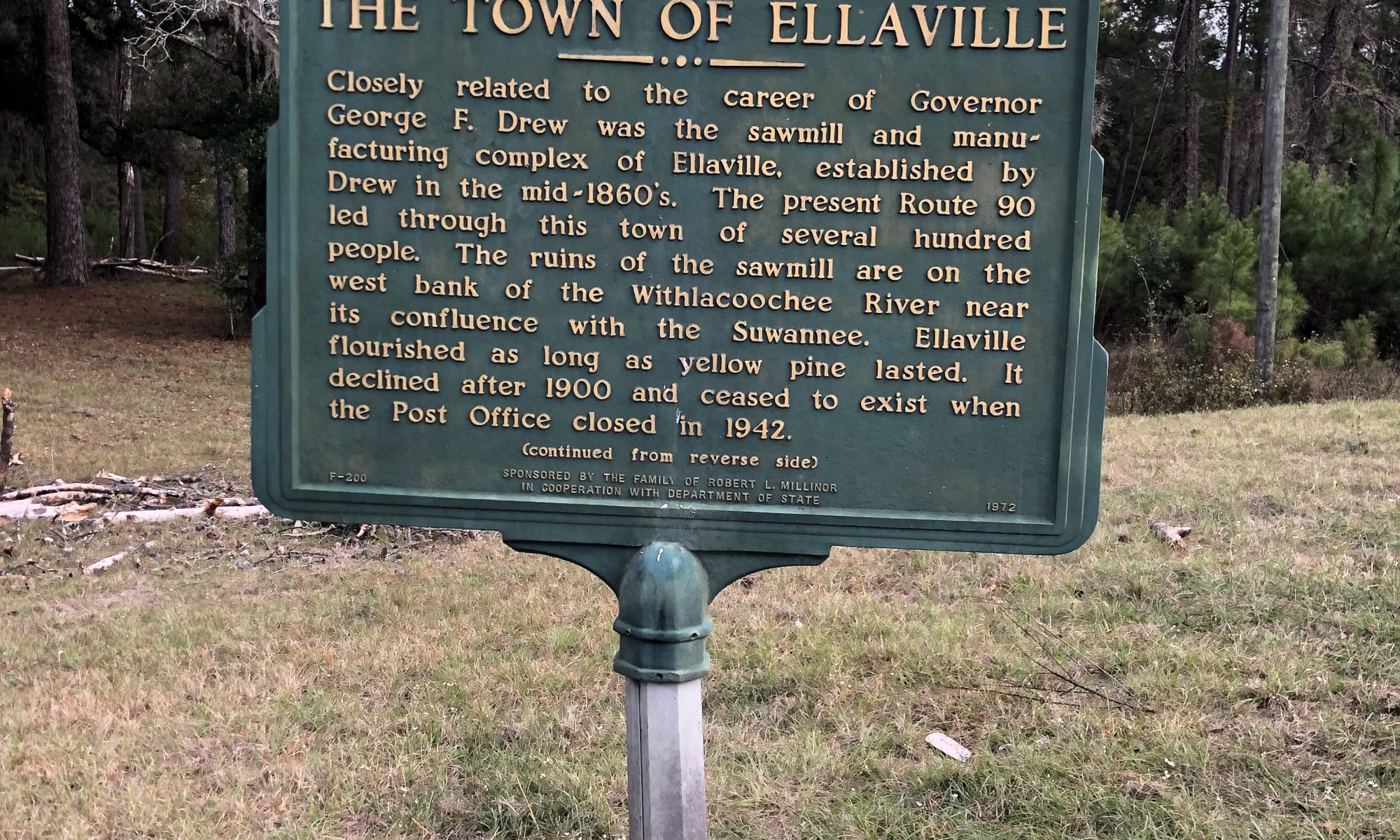
Years ago, when my son was still little, I took him out on the trails at Ellaville hoping we might find the ruins of George Drew’s mansion. We never made it that far. He had had enough walking, so we turned around. Now he is off at college, and I still remember how peaceful and beautiful those woods felt. A few years later, in 2019, I stopped and photographed the historical marker beside the road. In large letters, it says:

THE TOWN OF ELLAVILLE

Looking back at that picture now, what strikes me is how little of a town you can see behind it. There are trees, Spanish moss, grass and the familiar woods of North Florida. But Ellaville was not the first town here.

Before Ellaville, There Was Columbus

Columbus developed on the east side of the Suwannee in the early 1840s. Its location made sense because several different ways of moving through North Florida came together there. River traffic, ferries, stagecoach roads and mail routes all converged around the crossing, and later the railroad added another layer of importance.

Columbus became a place where cotton, goods, people and information moved through the region. Steamboats traveled the river. Stagecoaches connected the community with other settlements. A ferry carried people across the Suwannee.

By the Civil War, the railroad crossing was important enough that Confederate earthworks were built nearby to help defend it. For a while, Columbus seemed well positioned to last. Then a new town began growing across the river.

Ellaville Rises

After the Civil War, George Franklin Drew established a large sawmill and manufacturing operation on the opposite side of the Suwannee. North Florida was covered in yellow pine, and Drew built an economy around it. A town grew around the mill.

For several years, Columbus and the new settlement existed across the river from one another. One was an older transportation and river community. The other was a newer industrial town built around timber. Then the center of gravity began to shift.

In 1867, the Columbus post office was moved across the Suwannee to serve the growing sawmill complex, although it kept the Columbus name for a few more years. In 1872, the post office officially became Ellaville. By the early 1870s, Columbus had largely faded. Ellaville had taken its place.

George Drew built a substantial home there in 1868. Less than a decade later, he became governor of Florida. That detail helps me understand the scale of the place. Ellaville was not simply a small settlement beside a mill. For a time, it was one of the more important communities in this part of North Florida.

As Long as the Yellow Pine Lasted

Ellaville’s historical marker tells its story with an unusually simple sentence:

“Ellaville flourished as long as yellow pine lasted.”

There is almost an entire history of North Florida contained in those words. The forests that created Ellaville’s prosperity were also finite. As the surrounding timber was cut, the economic reason for the town began to disappear with it.

Ellaville declined after 1900. People left. Businesses closed. Houses vanished. The post office survived into the 1940s, but the town’s real boom had ended long before then. George Drew’s mansion remained standing after much of Ellaville had faded. Photographs from the twentieth century show the once-impressive house slowly deteriorating before it disappeared around 1970. The woods kept moving back in. Just as they had around Columbus before it.

What Stayed

Not everything disappeared. At Columbus, traces remain inside Suwannee River State Park: the cemetery, earthworks, old roads and places where people once approached the river. At Ellaville, the landscape is full of its own clues.

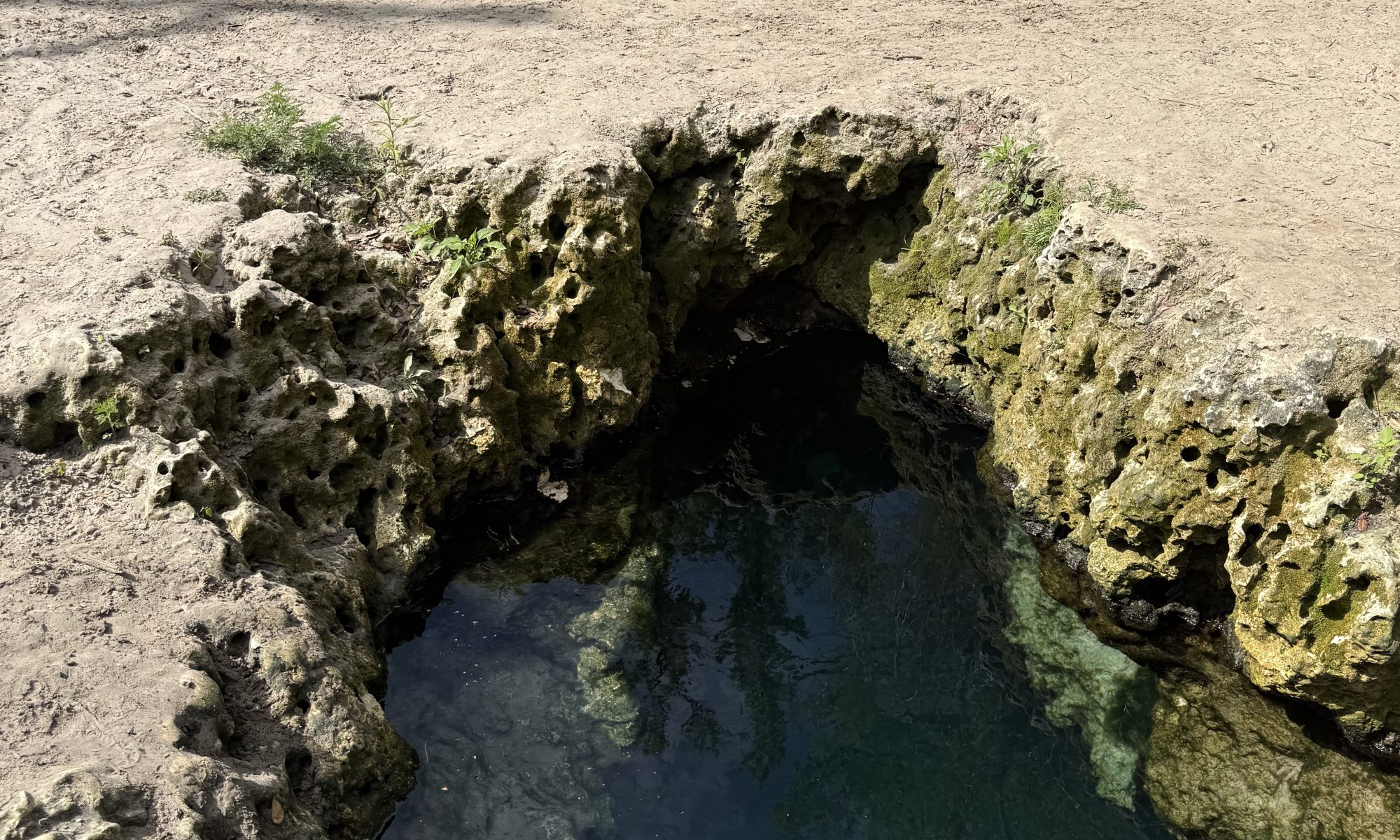
One of them is Suwanacoochee Spring. I remember paddling the Suwannee one day and passing the spring where its water enters the Withlacoochee. I was moving parallel to the shoreline when the outflow hit the side of my kayak hard enough that it nearly tipped me over.

That was my introduction to Suwanacoochee before I understood much about its connection to Ellaville. The walls around the spring are still there. The town is gone. The spring is not. Nearby, scattered ruins, old pathways and the landscape itself tell the same story in different ways. Once you know what was here, the empty spaces stop feeling quite so empty.

Two Towns, One River

What I find most interesting is how quickly the whole sequence happened. Columbus rose first, built around movement: ferries, stagecoaches, river commerce and later the railroad. Then Ellaville rose across the river, built around timber, manufacturing and transportation.

For a while, both towns existed at the same time. Then Columbus faded. A few decades later, Ellaville began fading too. Two towns rose along the same stretch of river, one after the other, and neither lasted very long.

The river stayed through all of it. The Suwannee and Withlacoochee kept flowing while one community rose, another replaced it, and eventually both disappeared back into the landscape.

That is one of the things I have come to love about exploring North Florida. Sometimes the most ordinary-looking woods are not ordinary at all. Sometimes they are the remains of one town. Sometimes two.

Experience It

This is a good place to explore as a pair. Start at Suwannee River State Park and look for the traces of Columbus: the cemetery, old roads and earthworks. As you walk, think about the stagecoaches, ferries and river traffic that once made this a crossroads.

Then walk across the old U.S. 90 bridge over the Suwannee into Ellaville. The bridge itself came much later than either town, but crossing the river on foot gives you a physical sense of just how close these two communities were.

On the Ellaville side, stop at the historical marker and walk the trails toward the Drew Mansion ruins. Find Suwanacoochee Spring near the meeting of the Suwannee and Withlacoochee and notice the walls still surrounding part of the water.

Neither place gives up its story immediately. That is part of what makes them worth visiting. You have to slow down, look carefully and imagine what is no longer there. Two towns once occupied this stretch of river. Now the river is what remains.

— Dion, Anasa founder
I Knew Sheck Exley Before I Knew Who He Was

For years, Sheck Exley existed in my memory as one of my high school math teachers. He was eccentric, interesting, and hard to forget. He had sayings he seemed to keep ready for almost any situation, including one I still remember clearly: “It’s my way or the highway.”

I knew he was involved in karate. I knew he had a personality that could fill a classroom. What I did not know was that he was also one of the most accomplished cave divers in the world. At the time, I had no idea.

The Blackboard

I remember one day in his class when he had students come to the blackboard to work algebra problems. When my turn came, I was feeling pretty confident. The equation looked easy, so I walked quickly to the board, worked it out, and was already prepared to enjoy being right. Except I wasn’t.

I had made some stupid little mistake. Sheck responded with one of those funny sayings he always seemed to have ready. I wish I could remember exactly what he said. Whatever it was, I remember slumping back into my seat, slightly embarrassed and already biding my time until I could get another chance to demonstrate my brilliance.

Looking back, what strikes me is that he could have skewered me. I had walked to that board with enough teenage arrogance to make myself an inviting target. He could have made the mistake hurt a lot more than it did. Instead, he showed me some grace and let me sit down. That is the Sheck Exley I knew then.

Meeting Him Again

Some years after high school, I was at the house of a friend of a friend when I noticed one of Sheck’s books sitting on the coffee table. I picked it up and starting looking through the book. And pretty much stopped participating in whatever everyone else was doing.

I sat there reading about cave exploration and underwater passages hidden beneath the North Florida landscape I had grown up around. The more I read, the stranger the experience became. This was Sheck Exley, my math teacher. Except it felt like I was reading about someone I had never met.

The person in those pages seemed almost entirely new to me. I had sat in his classroom. I knew his sayings. I knew about the karate club. I had even had my own small encounter with his sense of humor at the blackboard. But I had no idea how much of his life existed somewhere else entirely.

A Modern-Day Explorer in Our Own Backyard

What makes that realization even stranger is how often his story now intersects with places that were already part of my own life.

Telford Spring was one of those places. I spent countless childhood afternoons there, swimming through the limestone opening beneath the natural bridge and never imagining how far the cave system extended beyond what I could see. Years later, I learned that Sheck was one of the divers involved in exploring and surveying those passages.

Peacock Springs is another. My dad took my sister and me there long before it became a state park, back when the dirt road through the woods was part of the adventure. Today, Peacock is known around the world for its cave system, and there is a plaque there honoring Sheck.

Then there is Falmouth, another spring with an enormous hidden world beneath what looks like a small patch of water at the surface.

The more I learn about these places, the more often his name appears.

We tend to imagine explorers as people from another century, crossing oceans, climbing mountains, or disappearing into blank spaces on old maps. But Sheck was a modern-day explorer working right here in our own backyard, pushing into underwater passages beneath North Florida that most people would never see.

It is an odd feeling to keep encountering someone years after they are gone.

Someone I Had Never Met

Sheck died in 1994 while attempting an extraordinarily deep dive in Mexico. By the time I really understood the scale of what he had accomplished, he was already gone.

That is probably why the coffee-table book memory has stayed with me. I was not discovering a famous cave diver who happened to share a name with one of my old teachers. I was discovering that one of my old teachers had been this person all along.

There is something humbling about realizing how little we may know about the people sitting right in front of us. I knew Sheck Exley. And in another sense, I did not know him at all.

Experience It

If you visit Wes Skiles Peacock Springs State Park, look for the plaque honoring Sheck Exley. Then walk the interpretive trail that follows the cave system beneath the woods. From the surface, the landscape looks quiet and ordinary: pines, oaks, sandy trails, and patches of water tucked into the forest. But beneath your feet is another world.

That was the world Sheck spent so much of his life exploring. And if you want to understand him beyond the plaque, find one of his books and read it.

That is how I first discovered the other Sheck Exley. Years after sitting in his classroom, I picked up one of his books from a coffee table and found myself completely absorbed in the story of a modern-day explorer I had somehow already met.

For me, Peacock connects those two versions of the same person: the eccentric math teacher I remember from a classroom and the explorer whose name I now keep finding beneath the places I grew up around.

Sometimes we discover hidden stories in landscapes. Sometimes we discover them in people. And sometimes it takes years to realize just how much was there all along.

— Dion, Anasa founder

The Spring That Feels Like Home

My dad took my sister and me to Telford Spring so often when we were kids that it almost felt like our backyard pool. I can still picture the old oak tree overlooking the spring, with my boombox propped against it playing cassette tapes filled with whatever 80s music I was into at the time.

My dad was not especially cautious about the water. I remember him teaching one of my cousins how to swim by throwing him into the cold spring and letting necessity handle the lesson. My cousin figured it out pretty quickly.

We always stayed there for hours. Long enough that the cold water would eventually get to us, and we would swim out into the Suwannee for a while just to warm up before getting back in the spring.

One of my favorite things to do was turn the spring into a challenge. I would dive in, swim through the cave beneath the limestone bridge, then keep going down the spring run toward the river, all underwater, just to see how far I could make it on one breath. At the time, I had no idea how much more water and limestone existed beyond what I could see.

For most of my childhood, Telford was simply a place we went. We swam, listened to music, and spent enough time there that it stopped feeling like somewhere we visited and started feeling like somewhere that belonged to us.

For all those years, though, I never really wondered who Telford was.

The Name Behind the Spring

The man behind the name was Reverend William Brazelton Telford, a Presbyterian minister who came to this part of North Florida around 1864, during the final years of the Civil War, and became associated with the Luraville area.

We know the spring came to bear his name. What is harder to recover is exactly why. Some accounts suggest he may have owned or homesteaded land in the area, but I have not found enough to say with confidence that the spring itself was part of his property. I have also found later memories of baptisms taking place at Telford, but nothing that proves Rev. Telford himself performed them there.

That uncertainty is part of what interests me. Perhaps the connection once seemed so obvious to the people living here that nobody thought it needed to be written down. More than 150 years later, the name has survived more clearly than the story behind it.

Sometimes history does not remain as a building or monument. Sometimes it survives because people keep saying a name.

The World Beneath Telford

As a kid, the little cave beneath the limestone bridge felt like the hidden part of Telford. It turns out I barely knew the beginning of it.

Beneath the spring is an underwater cave system extending far beyond the small passage we swam through. Cave divers spent years exploring and surveying those passages, eventually connecting Telford with other parts of the underground system beneath the surrounding landscape.

One of the people involved in that early exploration was Sheck Exley. That name means something different to me than it does to most people who know the history of cave diving. Sheck was one of my high school math teachers.

At the time, I knew him as an eccentric and interesting teacher who liked to say, “It’s my way or the highway.” I knew he was involved in karate. I did not understand the other life he was living beneath the waters of North Florida.

I would not learn until much later that he had helped explore places like Telford. By then, he had already been my teacher and had tragically passed away. I had known the teacher. I had known the spring. I simply had no idea, at the time, how closely those two parts of my world were connected. That is another story.

A Place Can Hold More Than One Life

The older I get, the more I realize that familiar places can hold stories we never knew were there. Telford was part of Rev. Telford’s North Florida. Later, it became part of Sheck Exley’s underwater world. And for me, it was part of childhood. The history does not replace any of those memories. It adds layers to them.

I can learn about the preacher whose name survived. I can look at maps of cave passages that extended far beyond anything I imagined as a kid. I can understand now that one of my teachers had explored beneath a place where I spent countless summer afternoons.

But when I picture Telford, that is still not what I see first. I see the oak tree. I hear cassette tapes playing from a boombox. I see my sister nearby and my dad at the spring.

Experience It

On one side of the limestone bridge is a small opening where I used to jump in the water. From there, you can swim through the short cave beneath the rock and emerge into the main spring. The water turns cold around you almost immediately.

Then look down the spring run toward the Suwannee, where the clear spring water meets the darker river. If you stay in the spring long enough, you may even understand why we sometimes climbed into the river just to warm up.

Before you leave, follow the trail back to the parking lot, walk to the left, and down into the nearby sinkhole. It connects into the larger Telford cave system, a reminder that what you see at the surface is only a small part of what is beneath you.

Then come back to the spring and sit beneath the oaks for a while. It is not a large place. It is not polished. It does not need to be.

Places become important for all kinds of reasons. Sometimes because of the history attached to them. Sometimes because of the people who explored them. And sometimes because someone you loved took you there again and again.

The water is still cold. The limestone is still there. And for me, so is my dad.

— Dion, Anasa founder