The Name in the Woods

My dad started taking me to Peacock Springs long before it became a state park. Back then, at least in my memory, it felt like little more than a dirt road disappearing into the woods.

That road was part of the adventure. It rolled up and down enough that my sister and I treated it like a roller coaster, sitting on the back of my dad’s MGB while he drove faster over the hills than I would probably recommend today.

At the end of the road was Peacock Springs. I knew the name long before I ever wondered where it came from.

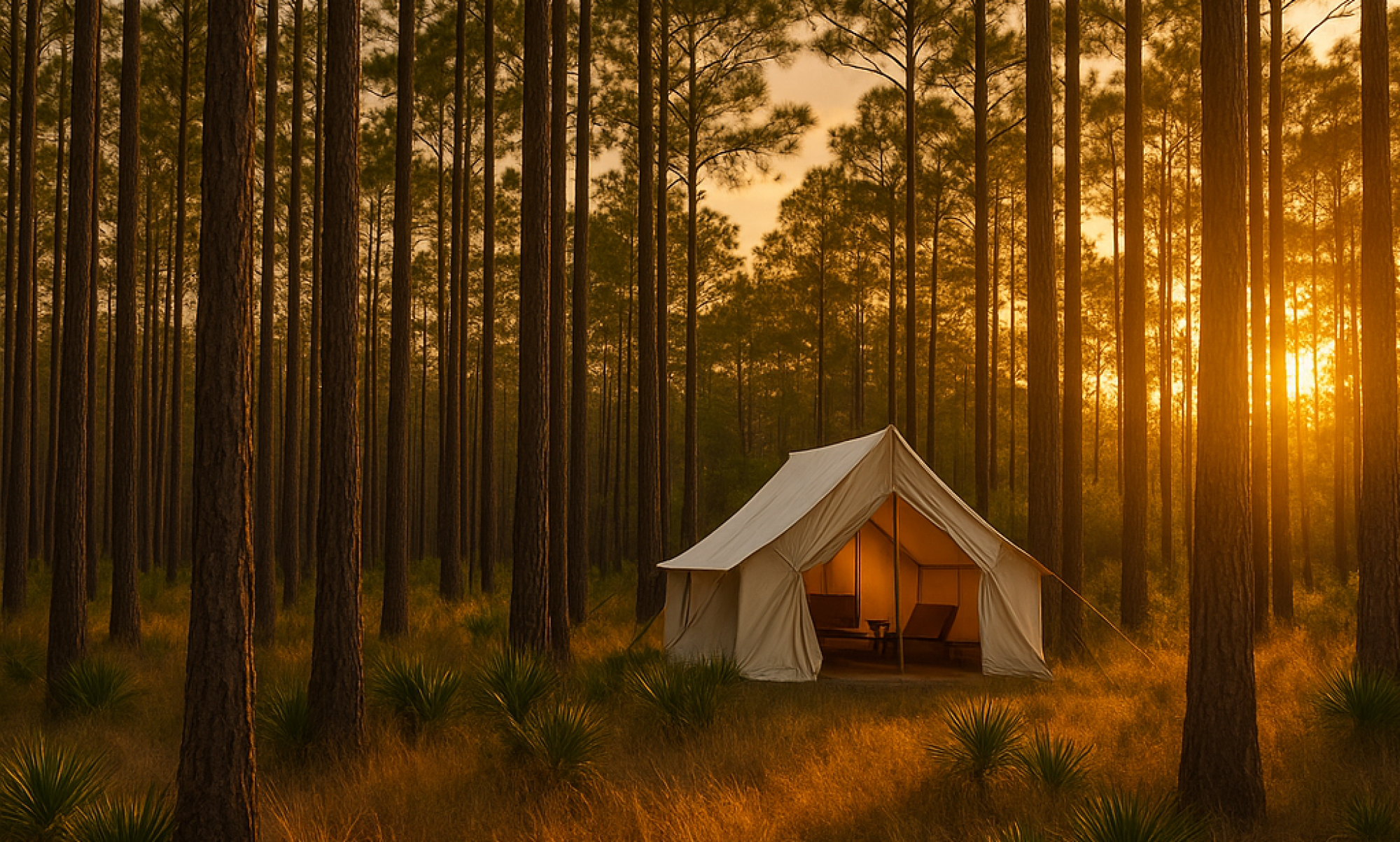
Today, Wes Skiles Peacock Springs State Park still feels surprisingly wild. It is not polished in the way some Florida state parks are. The roads are simple, the woods grow close, and the springs seem tucked into the landscape rather than built around.

There is something almost primordial about it.

And yet, on almost any visit, you are reminded that this quiet patch of North Florida is known far beyond North Florida. Cars in the parking area carry license plates from around the country. Sometimes you hear accents from other parts of the world.

They have come because beneath these woods lies one of the most extensive underwater cave systems in the country. But long before Peacock became a name known among cave divers, it was the name of a family.

Before the Divers Came

Dr. John Calvin Peacock came to this part of Florida from North Carolina in the years before the Civil War and settled near the springs that would eventually carry his family name.

The Peacock family built a life here. They farmed a large tract of land, raising cattle and growing crops, while Dr. Peacock practiced medicine throughout the surrounding countryside.

It is easy today to picture a doctor working from an office or hospital. In rural North Florida in the nineteenth century, the job looked very different. A country doctor might travel for miles by horse or buggy to reach someone who needed him.

The roads would have been rough. The communities were scattered. Much of the landscape between them was still forest.

Somewhere in those woods, the Peacocks built their home and raised their family. And eventually, they buried members of that family there.

The Cemetery

Not far from the springs is the Peacock family cemetery.

For many years, it became overgrown enough that it nearly disappeared back into the woods. Later, the cemetery was restored and marked, preserving one of the clearest physical connections between the family and the landscape that now carries their name. I like that the cemetery is still there.

The springs have become famous for something the Peacock family could never have imagined. Divers now travel thousands of miles to explore passages deep beneath their former land. Maps show miles of underwater cave extending beneath a landscape that, from above, still looks mostly like woods. But the family remains there too.

Their name appears on park signs, maps, cave surveys and dive logs.

Most people who say “Peacock Springs” probably never stop to wonder who Peacock was. For most of my life, I didn’t either.

A Name Can Outlive a Place

That has become one of the things I notice more often as I learn the stories of North Florida. Names survive. A ferry disappears, but Charles Spring remains. A preacher passes through a community, and generations later his name may still be attached to a spring.

A family settles beside a patch of woods in the nineteenth century, and people from around the world eventually travel there carrying dive tanks beneath a sign bearing their name.

The places change. The reasons people come to them change.

But sometimes the name stays.

I wonder what Dr. Peacock would think if he could stand near the spring today and watch divers preparing to disappear beneath the water.

He probably would not recognize much of what they were doing. But he would recognize the woods. And he would certainly recognize the name.

Experience It

One of the best ways to experience Peacock Springs is to walk the interpretive trail that follows the cave system beneath the ground.

From the surface, it looks like a walk through ordinary North Florida woods. But beneath your feet are miles of flooded passages twisting through the limestone. The trail helps connect the landscape you can see with the one you cannot. That changes the way you walk through the place.

The woods stop feeling like empty space between the springs. You begin to understand that there is another landscape directly below you, hidden beneath the roots and soil.

While you are there, look for the plaque honoring Sheck Exley, one of the pioneers of modern cave diving.

That plaque has a different meaning for me because Sheck was once one of my high school math teachers. At the time, I knew him as an eccentric and interesting teacher who liked to say, “It’s my way or the highway.” I knew he was involved in karate. I did not fully understand that he was also helping explore and map the underwater world beneath places like this.

That is a story for another Field Note. For now, walk the trail slowly.

Think about the Peacock family who lived here before the park existed. Think about the divers who later came to understand what was hidden below. Then look around at the same woods that have been here through all of it.

The Peacock family gave this place its name. Generations later, people like Sheck Exley helped us understand what was hiding beneath it.

And once you know both stories are there, the woods feel a little different.

— Dion, Anasa founder

When the Stars Come Out

If you live in or near a city, you can go a long time without really seeing the night sky.

There are always lights somewhere. Streetlights line the roads, houses glow through the trees, parking lots stay illuminated long after dark, and the city itself throws enough light into the sky that many of the stars simply disappear from view.

Drive far enough into rural North Florida, though, and the night begins to look different.

Once the last light fades behind the trees and you get away from the glow of town, your eyes slowly begin to adjust. At first, you notice a few stars. Then a few more. Give it enough time, and the sky seems to keep filling in.

That experience always reminds me that darkness has become something many of us have to intentionally seek out.

For most of human history, a clear night meant looking up at thousands of stars. People used them to navigate, mark the seasons, tell stories, and make sense of the world around them. Today, many of us live beneath skies brightened by artificial light, and we rarely stop to think about how much has disappeared above us.

Of course, nothing has actually disappeared. We have simply made it harder to see.

A Different North Florida After Dark

We spend a lot of time talking about North Florida’s water, and for good reason. The springs and rivers are some of the most remarkable parts of this landscape.

But there is another side of North Florida that does not reveal itself until after sunset.

Once you get away from the larger towns and highways, there are still places where darkness feels like darkness. On a clear night, the number of stars can be startling if you are accustomed to a city sky. Under the right conditions, you may even be able to make out the hazy band of the Milky Way stretching overhead.

The experience is not only visual. The woods sound different after dark. Frogs and insects replace the daytime birds, an owl may call somewhere beyond the trees, and the breeze seems easier to notice when everything else settles down.

A place that felt familiar an hour earlier can feel completely different once the sun disappears.

There is something about sitting outside in that darkness that makes it easier to slow down. You can talk, listen to the fire, watch the sky, or simply sit quietly for a while without feeling like you need to move on to the next thing.

Sometimes that is enough.

Experience It

You do not need much to experience a dark North Florida sky. In fact, the less you bring with you, the better.

Find somewhere away from city lights on a clear night and give your eyes time to adjust. Put your phone away for a while, or at least turn the screen down. If you need a flashlight, use it sparingly. After twenty or thirty minutes in the darkness, you will begin noticing stars that were invisible when you first stepped outside.

You do not necessarily need to know what you are looking at, either. There are apps that can identify planets and constellations, and they can be useful, but sometimes I think we are too quick to turn every experience into something we need to understand or accomplish.

Sometimes it is enough simply to look up.

If you are near the Suwannee, spend some time beside the river after dark. If you are camping, let the fire burn down and see what begins to appear above you. If you are somewhere quiet enough to hear frogs, insects, and wind instead of traffic, stay outside a little longer than you normally would.

North Florida gives us plenty of reasons to explore during the day, but some of its best moments happen after we normally would have gone inside.

The stars have been there all along. Sometimes we just need to get somewhere dark enough to see them.

— Dion, Anasa founder

Baptizing Spring

I had driven past Baptizing Spring more times than I could count before I ever saw it.

It sits in an undeveloped part of Peacock Springs State Park, across the road from Peacock Springs and Orange Grove Sink. Those places are destinations, drawing people to swim, dive, and explore some of North Florida’s remarkable waters.

Baptizing Spring is different. The spring itself is small, especially by North Florida standards, and isn’t really suited for swimming. Even if it were easier to reach, it probably would never become the kind of spring people plan a day around.

What makes Baptizing Spring remarkable isn’t really the spring at all. It’s the stories hidden around, and beneath, it.

I first visited about five years ago after asking park management for permission to go back there. I knew the name, but I knew almost nothing about its history. I certainly didn’t realize that hidden in those woods was the site of a seventeenth-century Spanish mission and a Native community whose story began more than two hundred years before the Charles family established their ferry on the Suwannee.

In the early 1600s, Spanish Franciscan missionaries established San Juan de Guacara here among the Native people already living in this part of Florida. Archaeological excavations at Baptizing Spring have uncovered evidence of structures, hearths, storage areas, and other features of everyday life. This wasn’t simply a place where missionaries occasionally stopped. It was a community.

That discovery changed the way I thought about the history of this area. It’s easy to imagine North Florida’s story beginning with settlers, ferries, railroads, and the small towns we know today. In reality, people had been living, traveling, trading, and building communities across this landscape for centuries before Florida became an American territory.

San Juan de Guacara was part of the Spanish mission system that stretched across northern Florida. The missions brought Christianity, but they were also part of Spain’s colonial system, placing growing demands on the Native communities around them. Those tensions eventually contributed to the Timucua rebellion against Spanish authority in 1656, after which the mission at Baptizing Spring was abandoned and relocated west toward an important crossing of the Suwannee River.

That caught my attention because it takes us back to the subject of our last Field Note: Charles Spring.

More than 150 years before Reuben and Rebecca Charles established their ferry there, people had already recognized the importance of that same area as a crossing of the Suwannee. Long before Bellamy Road reached the river, this landscape was already connecting people.

There may even be a connection between San Juan de Guacara and the name Suwannee itself. The origin of the word isn’t settled, but one theory traces it to the Spanish San Juan. Historical maps show the river under that name and later variations before spellings resembling Suwannee began to appear. We may never know the answer with certainty, but the possibility adds another fascinating layer to the story of this otherwise unassuming place.

Baptizing Spring has another surprising connection, although this one is underground.

In 2010, cave divers connected Baptizing Spring to the extensive Peacock Springs cave system across the road. From the surface, the two places seem separate. Peacock is one of Florida’s best-known cave-diving destinations, while Baptizing Spring is a small spring hidden in undeveloped woods. Beneath the ground, however, they’re part of the same system.

I love that contrast because it captures Baptizing Spring perfectly. Almost everything interesting about this little spring is something you cannot see at first glance. Its water connects underground to Peacock Springs, its woods conceal the remains of a community that existed four centuries ago, and its history reaches west toward the Suwannee.

The spring may be small, but its connections are anything but.

Experience It

Baptizing Spring itself will probably never be a North Florida destination, and perhaps that’s fitting. It also isn’t a place I would encourage anyone to simply wander into. The spring lies in an undeveloped part of the state park, and when I visited, I first asked park management for permission. More importantly, it is an archaeological site worth protecting.

Fortunately, you don’t have to visit Baptizing Spring itself to experience the landscape that makes its story meaningful.

Visit Peacock Springs and Orange Grove Sink across the road. Walk beneath the oaks and pines, look at the limestone beneath your feet, and spend some time around the water. While you’re there, remember that the cave passages beneath you extend beyond the places you can see and connect to that little spring hidden in the woods nearby.

Then consider another connection you can’t see. More than four centuries ago, people were living and building a community in those same woods.

When I finally visited Baptizing Spring about five years ago, I thought I was simply seeing an obscure spring I had driven past for years. I know now that its obscurity is part of what makes it so interesting.

Some places are worth knowing about even if you never visit them. Baptizing Spring is one of those places.

– Dion, Anasa Founder

Charles Ferry

Some of my earliest memories of Charles Spring have nothing to do with history. 

When I was growing up, my dad used to take me there to fish for catfish. We’d climb out onto a large, flat limestone rock overlooking the Suwannee River, bait our hooks, and settle in for the afternoon. It was always quiet, and most days we had the place to ourselves.

To me, it was simply a good place to fish with my dad.

I never wondered why it was called Charles Spring. I didn’t know there had once been a Charles Ferry, or that the small cemetery tucked beneath the oaks belonged to the family whose name still lives on across this landscape. I certainly didn’t realize that this quiet bend in the river had once helped connect a young Florida.

When the United States acquired Florida in 1821, the new territorial government faced a practical challenge. St. Augustine remained the territory’s oldest and most established city, while Tallahassee had been chosen as the new capital because it sat roughly between the former capitals of East and West Florida. Connecting those communities became essential, so Congress authorized the construction of the Bellamy Road, the first federally funded road in Florida.

The road crossed the Suwannee River at Charles Ferry. That made this quiet stretch of river one of the most important gateways in the new territory.

Without a bridge, every traveler heading between St. Augustine and Tallahassee eventually reached the same obstacle. The road simply ended at the water, and if they wanted to continue their journey, they depended on the Charles family.

Recognizing both the need and the opportunity, Reuben and Rebecca Charles established a ferry, trading post, and inn here in 1824. For more than fifty years, they welcomed travelers arriving from both directions, helping them cross the Suwannee and continue on their way.

Imagine arriving after several days on horseback or by wagon. Your supplies are running low, your horse is tired, and the Suwannee stretches across your path with no bridge in sight. While you wait for the ferry, you refill your water at the spring, purchase provisions from the trading post, and exchange stories with other travelers who have reached the same crossing from the opposite direction. For a little while, everyone’s journey pauses here, not because they have reached where they intended to stop, but because they have reached the river. The ferry carried people across the Suwannee.

The Charles family helped keep Florida moving.

One story about the Charles family has always stayed with me. According to local tradition, Reuben and Rebecca maintained friendly relationships with the Native Americans who lived in this area during one of Florida’s most turbulent periods. It’s said they wore red scarves so they would be recognized and left unharmed.

Whether every detail can be proven or not, I appreciate that the story has survived. History isn’t preserved only in official records. Sometimes it’s preserved because a community continues telling it.

As Florida grew, new roads, railroads, and bridges gradually replaced many of the old crossings that had once been so important. Bellamy Road faded into history, and unlike Suwannee Springs, no bridge was ever built to replace Charles Ferry. The bustle disappeared, the river grew quiet again, and the buildings eventually vanished.

But the name remained. It lives on today in Charles Spring, Charles Ferry, and the Charles family cemetery, quietly reminding visitors that the people who once helped connect a young Florida have never completely disappeared.

Experience It

Charles Spring isn’t a place to rush through.

Park in the spring parking lot and walk out to the Bellamy Road historical marker and follow the old road toward the river. As you walk beneath the live oaks, imagine wagons making the same approach almost two centuries ago, knowing their journey could not continue until they found a way across the Suwannee.

Then continue to the river, where public boat ramps now serve both banks. The ferry is gone, but people still begin journeys from this very crossing. Fishermen launch before sunrise, families paddle the river, and kayakers drift past the same shoreline where travelers once waited for their turn to cross.

Spend a few minutes at Charles Spring, where fresh water made this a natural stopping place long before automobiles existed. 

Before you leave, take the short walk to the Charles family cemetery. Read the names. Read the dates. Then take one last look toward the river. The crossing is still here. The spring is still here. The family name is still here.

The next time I visit Charles Spring, I’ll probably walk back out onto that same limestone rock where my dad and I used to fish. The river hasn’t changed much since those afternoons, but I have. Now, when I look across the water, I won’t just see one of my favorite childhood fishing spots.

I’ll see one of the crossings that helped shape a young Florida, and I’ll remember the family that helped keep it moving.

— Dion