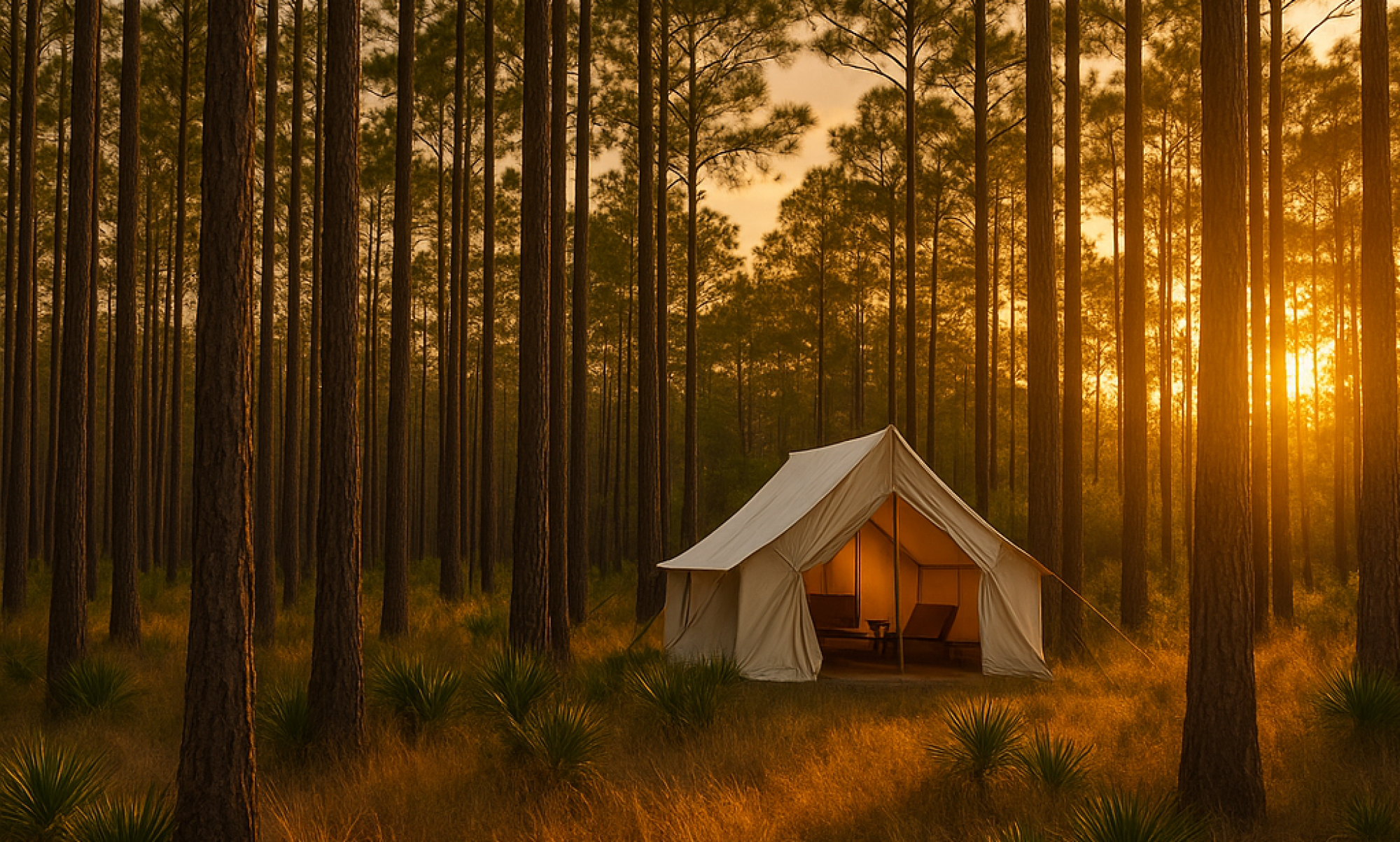
The Forgotten Resort on the Suwannee

There was a time when people traveled from all over the country to visit Suwannee Springs. Today, most people drive right past it without realizing it’s there.

The springs sit beneath a canopy of oaks along the Suwannee River, tucked away at the end of a quiet road. If you visit today, you’ll find the remains of stone spring walls, a few scattered ruins, and the river flowing much as it always has.

The spring itself is a sulfur spring. You’ll notice the smell almost immediately. It’s not unpleasant once you know what it is, but it’s certainly distinctive. More than a century ago, that mineral-rich water was the attraction. People believed the spring’s waters could help heal a variety of ailments, and they traveled hundreds of miles by train to experience them.

It’s hard to imagine now, but this was once one of Florida’s earliest tourist destinations. Over the years, grand resort hotels were built here to serve visitors who came seeking the mineral waters flowing from the springs. One after another, those resorts were destroyed by fire, leaving behind little evidence of what once stood here. The grounds are quiet. The river moves slowly past the springs. The oaks cast shade over ruins that many people never notice.

For most of my life, I didn’t think much about any of that. To me, Suwannee Springs was a place to swim. My favorite place to jump was from the far spring wall. To get there, I would walk along the top of the old spring structure, all the way around to the opposite wall. The jump felt a little higher there. The water felt a little deeper. Whether it actually was or not didn’t matter much. To me, it was the best place to jump.

I spent years visiting the springs without giving much thought to the people who came before me. Now when I stand there, I find myself looking at those same walls differently.

The wall I once jumped from was built during a time when visitors traveled hundreds of miles to experience these springs. And it’s strange to think that a place many Floridians have never heard of was once known well beyond North Florida.

I’ve always been fascinated by places like that. Not because of what they are today, but because of what they used to be. You can stand beside the spring walls and try to picture the people who once gathered there. Families arriving after long journeys. Visitors hoping the spring waters would improve their health. Guests walking the grounds of hotels that no longer exist. A bustling destination where today there is mostly quiet. What I find most interesting is how little remains.

Many of Florida’s historic attractions were replaced, redeveloped, or built over.

Suwannee Springs feels different. Nature has slowly reclaimed much of it. The river still flows past the springs. The oaks still shade the grounds. And if you look closely, you can still find traces of the people who believed this place was worth traveling hundreds of miles by train to see.

That’s one of the things I love about North Florida. It holds onto its stories. Not always in museums or history books. Sometimes they’re tucked away beside a river, waiting for someone curious enough to stop and look.

— Dion

P.S. Have you ever visited Suwannee Springs? I’d love to hear what you remember about it.
The Coastline That Disappeared

FIELD NOTES FROM NORTH FLORIDA

One of the most important features in North Florida is something most people never even notice. In fact, if you didn’t know it was there, you could drive past it a hundred times and never give it a second thought. Just like I did. 

Millions of years ago, it was Florida’s coastline. Today, geologists call it the Cody Scarp. 

The funny thing is that it isn’t especially dramatic. It’s not the Grand Canyon. It’s not a mountain range. In many places, it’s little more than a subtle change in elevation. But it may be the reason North Florida became such a unique landscape.

The first clue is that you can find shark teeth in the Suwannee River. Not at the beach. Not along the coast. In a river winding through pine forests and cypress swamps, miles and miles before it reaches the Gulf.

Long before there were springs, farms, roads, or even the Suwannee River itself, the sea reached much farther inland than it does today. The Cody Scarp marks one of those ancient shorelines.

North of that ancient shoreline, water tends to stay on the surface. South of it, water disappears into the limestone beneath your feet.

That’s where things start to get interesting. North of here, the Alapaha River can disappear entirely into the ground at a place called Dead River Sink. The river simply vanishes into the limestone.

Elsewhere, that same underground world sends water back to the surface, creating the springs that have drawn me back again and again throughout my life. Peacock. Telford. Madison Blue. Troy. And dozens more.

I spent years swimming in these springs before I understood why they were here at all. In many ways, the Florida I grew up loving exists because of a coastline that no longer exists.

The more time I spend exploring this part of Florida, the more I realize that many of the things I love about it trace back to this ancient shoreline. The springs. The sinkholes. The disappearing rivers. Even the shark teeth hidden in the Suwannee.

That’s one reason I love North Florida. It doesn’t reveal itself all at once. The beaches announce themselves. The theme parks advertise themselves. But North Florida asks you to pay attention.

And if you do, you’ll discover rivers that disappear, springs that emerge from nowhere, and traces of an ocean that vanished millions of years ago.

— Dion

P.S. Have you ever found a shark tooth in a river or creek? I’d love to hear where.

I Thought There Would Be Resorts Here

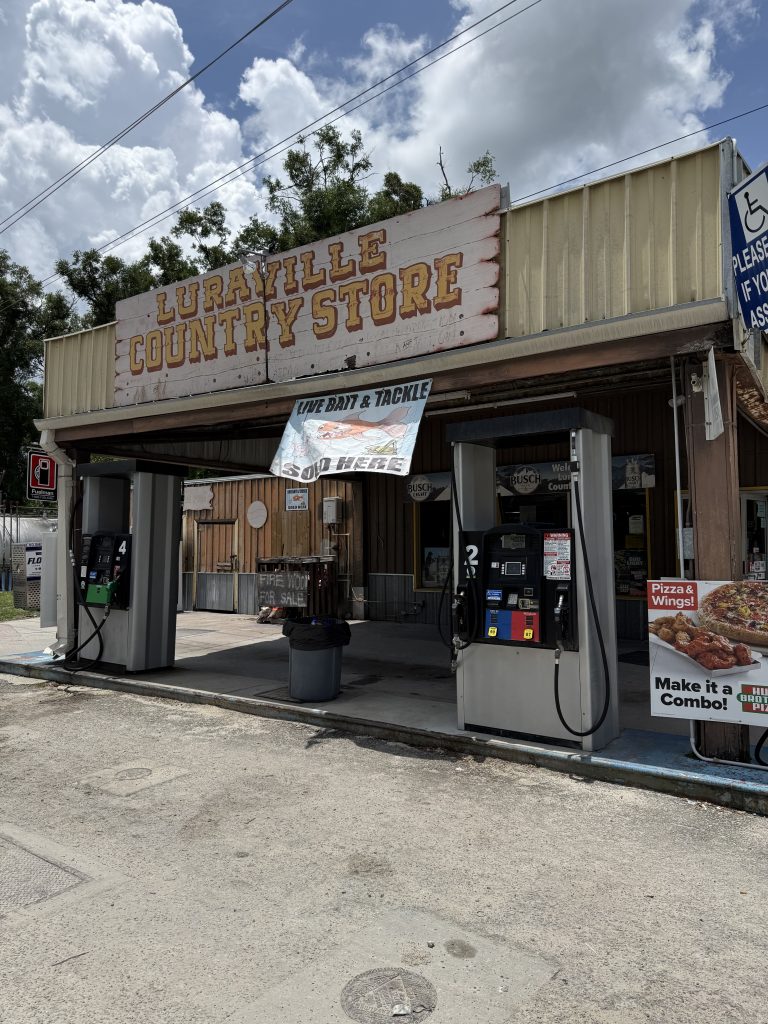
Luraville Country Store

As a kid, I was convinced this road would someday be lined with resorts.

If you’ve ever been to the springs along the Suwannee River, you might know the turn I’m talking about. You leave Highway 51 at the flashing light by the Luraville Country Store and turn left.

Even then, it felt like you were going somewhere special. I just assumed everyone else would eventually figure it out too. I imagined traffic. Hotels. Restaurants. Souvenir shops. Surely the rest of the world would discover what we already knew.

Instead, that road has barely changed in my lifetime. It’s still one of the quietest roads I know. And I’m glad.

The first spring along that road for me was Telford Spring.

I spent so many summer days there with my dad that I almost think of it as my home spring. It’s not the biggest spring in Florida. It never has been. But it has always felt special.

There’s a small spring basin, crystal-clear water, and a short cave you can swim through. Growing up, it was mostly a local spot. The kind of place where you recognized the other cars parked nearby.

At one point it was closed off and could only be reached by boat. Today it’s once again open to the public thanks to the water management district, and people still love it.

When I think about Telford, I don’t just remember the spring itself. I remember sitting beneath an old oak tree with my boom box propped against the trunk, 80s music playing while I swam in water so cold it almost hurt when you first jumped in. Those memories feel as clear as the water.

A little farther down the road is Peacock Spring.

Long before it became a state park, it was simply a dirt road disappearing into the woods. It still feels that way.

Peacock has a primordial quality to it. Even now, it feels more like a discovery than a destination. You won’t usually find crowds there. Instead, you’re likely to meet people who have traveled from around the world to dive one of the most remarkable underwater cave systems on earth.

One of my favorite memories is riding on the back of my dad’s green MGB convertible with my sister while he flew down that old bumpy dirt road. To us, it felt like a roller coaster.

Even today, Peacock can feel like it’s yours alone. Sometimes the only sign that anyone else is there, besides a few cars in the parking lot, is a stream of bubbles rising from deep below the surface, evidence of cave divers exploring the darkness beneath your feet.

Inside the park is Orange Grove Sink.

Most days, the surface is covered in duckweed, tiny flowering plants that create what looks like a solid green carpet across the water. But if divers are below, their bubbles often clear patches in the surface, revealing the clear water underneath.

One side of the sink is bordered by a towering limestone cliff. As teenagers, after hot days working in the tobacco fields, my friends and I would gather there and leap from the rocks, trying flips and tricks that seemed like a great idea at the time. I’m not sure I’d recommend all of our decisions. But I’d relive those summers in a heartbeat.

When I was young, I thought this road would become famous. I thought resorts would appear. I thought crowds would follow. Instead, it stayed mostly the same.

And maybe that’s the reason these places still feel so special.

— Dion

PS. The summer is a great time to visit North Florida.