When the Stars Come Out

If you live in or near a city, you can go a long time without really seeing the night sky.

There are always lights somewhere. Streetlights line the roads, houses glow through the trees, parking lots stay illuminated long after dark, and the city itself throws enough light into the sky that many of the stars simply disappear from view.

Drive far enough into rural North Florida, though, and the night begins to look different.

Once the last light fades behind the trees and you get away from the glow of town, your eyes slowly begin to adjust. At first, you notice a few stars. Then a few more. Give it enough time, and the sky seems to keep filling in.

That experience always reminds me that darkness has become something many of us have to intentionally seek out.

For most of human history, a clear night meant looking up at thousands of stars. People used them to navigate, mark the seasons, tell stories, and make sense of the world around them. Today, many of us live beneath skies brightened by artificial light, and we rarely stop to think about how much has disappeared above us.

Of course, nothing has actually disappeared. We have simply made it harder to see.

A Different North Florida After Dark

We spend a lot of time talking about North Florida’s water, and for good reason. The springs and rivers are some of the most remarkable parts of this landscape.

But there is another side of North Florida that does not reveal itself until after sunset.

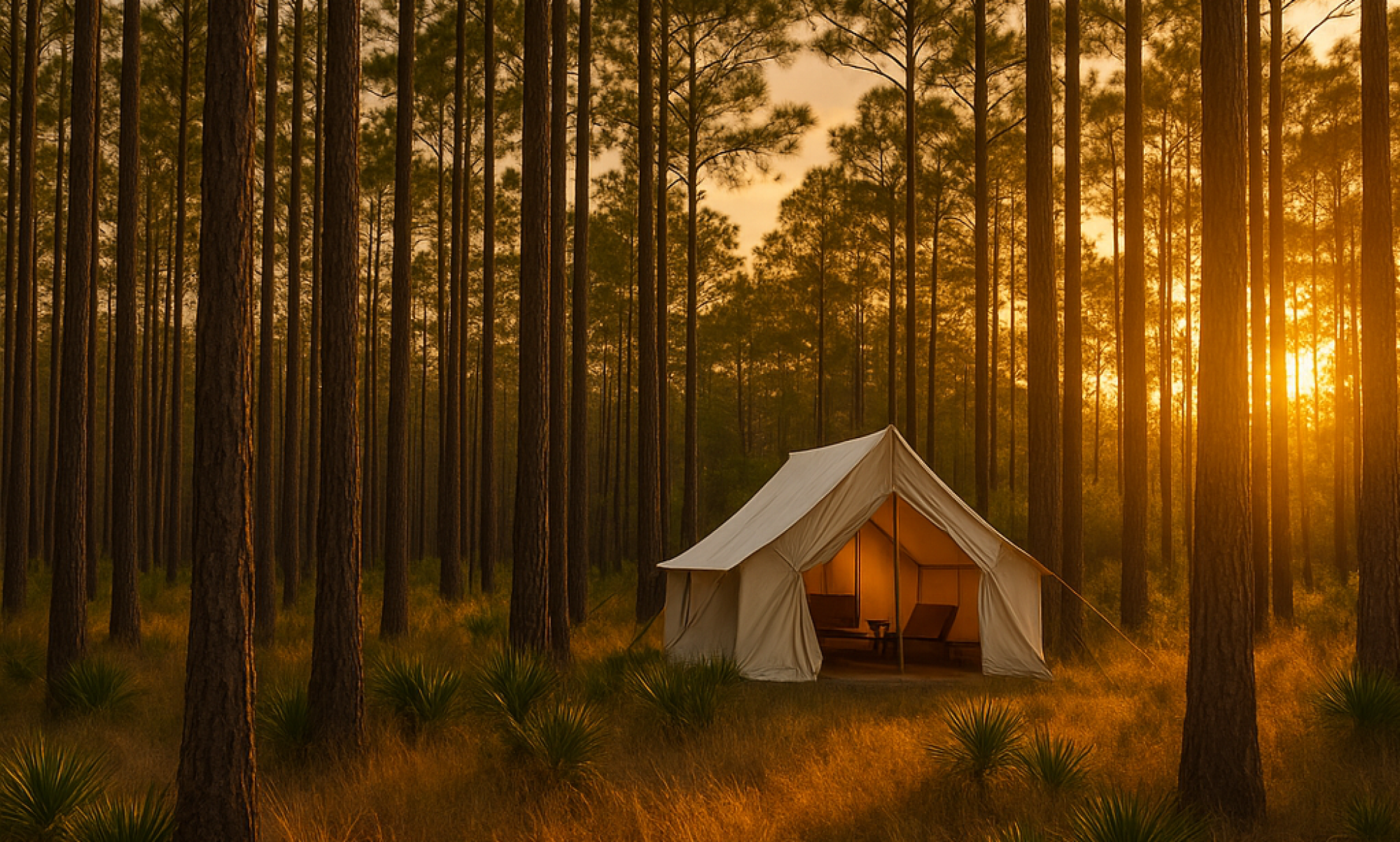
Once you get away from the larger towns and highways, there are still places where darkness feels like darkness. On a clear night, the number of stars can be startling if you are accustomed to a city sky. Under the right conditions, you may even be able to make out the hazy band of the Milky Way stretching overhead.

The experience is not only visual. The woods sound different after dark. Frogs and insects replace the daytime birds, an owl may call somewhere beyond the trees, and the breeze seems easier to notice when everything else settles down.

A place that felt familiar an hour earlier can feel completely different once the sun disappears.

There is something about sitting outside in that darkness that makes it easier to slow down. You can talk, listen to the fire, watch the sky, or simply sit quietly for a while without feeling like you need to move on to the next thing.

Sometimes that is enough.

Experience It

You do not need much to experience a dark North Florida sky. In fact, the less you bring with you, the better.

Find somewhere away from city lights on a clear night and give your eyes time to adjust. Put your phone away for a while, or at least turn the screen down. If you need a flashlight, use it sparingly. After twenty or thirty minutes in the darkness, you will begin noticing stars that were invisible when you first stepped outside.

You do not necessarily need to know what you are looking at, either. There are apps that can identify planets and constellations, and they can be useful, but sometimes I think we are too quick to turn every experience into something we need to understand or accomplish.

Sometimes it is enough simply to look up.

If you are near the Suwannee, spend some time beside the river after dark. If you are camping, let the fire burn down and see what begins to appear above you. If you are somewhere quiet enough to hear frogs, insects, and wind instead of traffic, stay outside a little longer than you normally would.

North Florida gives us plenty of reasons to explore during the day, but some of its best moments happen after we normally would have gone inside.

The stars have been there all along. Sometimes we just need to get somewhere dark enough to see them.

— Dion, Anasa founder
Baptizing Spring

I had driven past Baptizing Spring more times than I could count before I ever saw it.

It sits in an undeveloped part of Peacock Springs State Park, across the road from Peacock Springs and Orange Grove Sink. Those places are destinations, drawing people to swim, dive, and explore some of North Florida’s remarkable waters.

Baptizing Spring is different. The spring itself is small, especially by North Florida standards, and isn’t really suited for swimming. Even if it were easier to reach, it probably would never become the kind of spring people plan a day around.

What makes Baptizing Spring remarkable isn’t really the spring at all. It’s the stories hidden around, and beneath, it.

I first visited about five years ago after asking park management for permission to go back there. I knew the name, but I knew almost nothing about its history. I certainly didn’t realize that hidden in those woods was the site of a seventeenth-century Spanish mission and a Native community whose story began more than two hundred years before the Charles family established their ferry on the Suwannee.

In the early 1600s, Spanish Franciscan missionaries established San Juan de Guacara here among the Native people already living in this part of Florida. Archaeological excavations at Baptizing Spring have uncovered evidence of structures, hearths, storage areas, and other features of everyday life. This wasn’t simply a place where missionaries occasionally stopped. It was a community.

That discovery changed the way I thought about the history of this area. It’s easy to imagine North Florida’s story beginning with settlers, ferries, railroads, and the small towns we know today. In reality, people had been living, traveling, trading, and building communities across this landscape for centuries before Florida became an American territory.

San Juan de Guacara was part of the Spanish mission system that stretched across northern Florida. The missions brought Christianity, but they were also part of Spain’s colonial system, placing growing demands on the Native communities around them. Those tensions eventually contributed to the Timucua rebellion against Spanish authority in 1656, after which the mission at Baptizing Spring was abandoned and relocated west toward an important crossing of the Suwannee River.

That caught my attention because it takes us back to the subject of our last Field Note: Charles Spring.

More than 150 years before Reuben and Rebecca Charles established their ferry there, people had already recognized the importance of that same area as a crossing of the Suwannee. Long before Bellamy Road reached the river, this landscape was already connecting people.

There may even be a connection between San Juan de Guacara and the name Suwannee itself. The origin of the word isn’t settled, but one theory traces it to the Spanish San Juan. Historical maps show the river under that name and later variations before spellings resembling Suwannee began to appear. We may never know the answer with certainty, but the possibility adds another fascinating layer to the story of this otherwise unassuming place.

Baptizing Spring has another surprising connection, although this one is underground.

In 2010, cave divers connected Baptizing Spring to the extensive Peacock Springs cave system across the road. From the surface, the two places seem separate. Peacock is one of Florida’s best-known cave-diving destinations, while Baptizing Spring is a small spring hidden in undeveloped woods. Beneath the ground, however, they’re part of the same system.

I love that contrast because it captures Baptizing Spring perfectly. Almost everything interesting about this little spring is something you cannot see at first glance. Its water connects underground to Peacock Springs, its woods conceal the remains of a community that existed four centuries ago, and its history reaches west toward the Suwannee.

The spring may be small, but its connections are anything but.

Experience It

Baptizing Spring itself will probably never be a North Florida destination, and perhaps that’s fitting. It also isn’t a place I would encourage anyone to simply wander into. The spring lies in an undeveloped part of the state park, and when I visited, I first asked park management for permission. More importantly, it is an archaeological site worth protecting.

Fortunately, you don’t have to visit Baptizing Spring itself to experience the landscape that makes its story meaningful.

Visit Peacock Springs and Orange Grove Sink across the road. Walk beneath the oaks and pines, look at the limestone beneath your feet, and spend some time around the water. While you’re there, remember that the cave passages beneath you extend beyond the places you can see and connect to that little spring hidden in the woods nearby.

Then consider another connection you can’t see. More than four centuries ago, people were living and building a community in those same woods.

When I finally visited Baptizing Spring about five years ago, I thought I was simply seeing an obscure spring I had driven past for years. I know now that its obscurity is part of what makes it so interesting.

Some places are worth knowing about even if you never visit them. Baptizing Spring is one of those places.

– Dion, Anasa Founder

Crossing the Suwannee

Every time I cross the Suwannee River, I do the same thing.

It usually starts with the highway signs. If you’ve driven across the Suwannee in Florida, you’ve probably noticed them, the signs with musical notes, a nod to the song that made this river famous.

And almost without fail, I start singing: Way down upon the Suwannee River… I’ve done it for years.

But more recently I found myself wondering something I’d somehow never really thought about: How did people get across before there were bridges?

It occurred to me that I’d crossed the Suwannee hundreds of times. I knew the song. I knew the river. I’d even jumped off one of its bridges.

But I’d never really thought about the crossing itself. 

Once you look at a map, the importance of the Suwannee becomes obvious. The river begins in Georgia and winds south through North Florida before emptying into the Gulf. Travel west across this part of Florida and, sooner or later, you have to cross it. To truly go around it, you’d have to head north into Georgia before coming back down into Florida.

Today, crossing hardly qualifies as an obstacle. We drive across a bridge in less than a minute. But for much of Florida’s history, it was a very different problem. Travelers had to find a crossing. And at Suwannee Springs, you can still see how four generations of Floridians solved it.

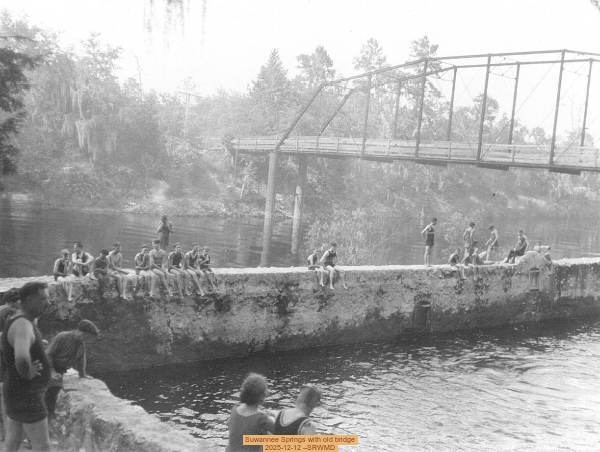
The earliest crossing at Suwannee Springs was a ferry. Before bridges connected the two banks, travelers arriving here had to stop and wait to be carried across. Eventually, the ferry was replaced by a bridge. That bridge was replaced by another. And that one eventually gave way to the modern crossing we use today.

Four generations of crossings, all within the same small stretch of river. Pieces of that history are still there. Near the spring, old rusted piers stand by the river, the remains of the first bridge that once carried travelers from one bank to the other.

Just downstream stands its successor, an old steel truss bridge that no longer carries traffic. Most locals know it simply as the Graffiti Bridge. And I knew that bridge long before I knew its history. When I was a teenager, the Graffiti Bridge was a popular swimming spot. And yes, we jumped off it into the Suwannee. More than once.

I’m certainly not recommending anyone repeat that particular part of the experience today. But whenever someone asks that old parental question, “If your friends jumped off a bridge, would you?” I suppose I have to answer honestly. Yes!

At the time, I wasn’t thinking about the bridge as history. It was simply part of growing up around the Suwannee. I didn’t know that another bridge had stood before it. I certainly wasn’t thinking about the ferry that came before either of them. It was just the river.

And maybe that’s what I find most interesting about these places. Sometimes we can know somewhere our entire lives without really knowing its story.

Think about how differently people have experienced this one spot.

There was a time when a traveler arrived at the Suwannee and had to stop. Was the ferry running? Was the river too high? How long would the crossing take?

Eventually, travelers crossed on a bridge. Years later, teenagers like me jumped from another one into the water below.

Today, most of us pass over the same river on a modern highway without giving the crossing much thought at all. The river is still there. The problem hasn’t changed. Every generation has simply found a different way across.

Experience It

The next time you’re near Suwannee Springs, don’t just cross the river. Stop for a while. Walk down to the spring and look out across the Suwannee. Imagine arriving here before there was a bridge and realizing that your journey couldn’t continue until someone carried you to the other side.

Look for the old bridge piers by the river. Then walk over to the Graffiti Bridge and stand on a crossing that itself became obsolete when the next generation built another one nearby. But please don’t follow my teenage example and jump off it!

Instead, take a few minutes to notice something that’s easy to miss: In one small stretch of the Suwannee, you can see the story of how North Florida learned to cross a river. And when you get back in the car and drive across the newest bridge, maybe do what I do. Sing a few words.

Way down upon the Suwannee River…

Only now, look down. And think about all the people who had to figure out how to get to the other side.

— Dion

Maybe she was paying attention all along

A few days ago, I was walking into a doctor’s appointment when my phone buzzed.

It was my daughter, Kendall. She’s in her first semester at FSU (Go Noles!) and she wanted to share something she workshopped in class.

I’ll admit it, I found myself wiping away tears in the hallway. Not because it was my daughter who wrote it, although I’m certainly a proud dad. But because every now and then someone puts words to something you’ve carried in your heart for a long time, and that’s exactly what she did.

As parents, we spend years hoping we’ve passed along something worthwhile. Kindness. Curiosity. A love of people and places. The ability to notice things others walk past.

Reading her poem, I realized something.

Maybe she was paying attention all along.

She gave me permission to share it, and I’m grateful she did. I hope it resonates with you the way it did with me.

Springs on the Suwannee

by Kendall Sweat

Somewhere

I sit among the bald cypresses and swamp gums

with my feet dipped in the cold, clear water,

anchoring me to the moment,

allowing me to stretch my own roots into the soil.

The water bugs dance past me

gliding like figure skaters across the surface,

whispering to me stay afloat

and trust the unseen.

The sun places a blanket over my soul,

encouraging me to curl up

among the bald cypresses and swamp gums

and let my body rest.

I melt into the land that I lie on:

my limbs become the trees,

my blood transforms to water,

my soul joins the dancing water bugs.

I am distant from civilization,

distant from the screaming cars

and the imposing skyscrapers;

the gray, dead concrete.

Somewhere

I sit among the bald cypresses and swamp gums

and their roots reach out to mine,

announcing where I belong.

Most people drive right past some of Florida’s most beautiful places

I’m writing this from a family vacation at Vilano Beach.

The ocean is right outside. The weather is great, by Florida’s standards. The kind of trip that reminds you why getting away matters.

Watching people enjoy the beach got me thinking about something from when I was a kid. Most people come to Florida for the beaches. Or the amusement parks. And for good reason.

But growing up in North Florida, I was always more excited about going to the springs. Honestly, I thought they were better than amusement parks. The water was clear enough to see the bottom. The rivers felt wild. And every trip felt like discovering something most people didn’t know about.

I remember being convinced that someday everyone else would figure it out too. I thought there would eventually be resorts lining the roads to my favorite springs. Hotels. Traffic. Gift shops. The whole thing.

Looking back, it’s kind of funny. Many of those roads still wind through pastures where the cows outnumber the people.

And while millions of visitors are heading for the beaches and theme parks, they’re often driving right past some of the most beautiful places in the state without ever knowing they’re there.

That’s one of the things I love most about North Florida. Not because there’s nothing to do. But because so much of what makes it special hasn’t been turned into an attraction.

So now I’m curious. What’s a place you’ve visited that still feels undiscovered? Could be in Florida or anywhere else.

I’d love to hear about it.

Dion, Anasa Founder