We Never Found the Big Oak

Big Oak Tree

I have wanted to hike the Big Oak Trail for years. The route is part of the larger Florida National Scenic Trail, a long-distance hiking trail that stretches more than 1,000 miles across the state. And it’s been described as one of the most scenic hikes in North Florida.

I grew up in this part of North Florida, not far from the Suwannee River, but I do not remember hearing much about the Florida Trail when I was younger. It certainly was not something I gave much thought to. It was only much later in life that I began to appreciate just how much there was to discover in the places I had grown up around.

I cannot remember when I first read about it, but somewhere along the way it became one of those North Florida places I kept meaning to see. I had read about this enormous old oak tucked into the woods near the Suwannee, and over time I probably romanticized it more than a little. I imagined finally coming around a bend in the trail and seeing it there, the kind of tree that makes you stop and stare because of how long it has been standing.

So when we finally set out to find it, I had the destination firmly in mind. When we reached the trailhead after parking, there was already some concern about what we had gotten ourselves into. Katie, especially, was looking at the overgrowth with considerably less optimism than I was. I was certain the trail would get better, and it did, somewhat.

The orange-blazed Florida Trail was passable and easy enough to follow, but there was still plenty of vegetation crowding the path. Even so, hiking along the Suwannee is rarely a bad way to spend a morning, and I was still convinced that once we got farther in, the trail would open up and the Big Oak would be waiting for us somewhere ahead.

Then we turned onto the blue-blazed trail that was supposed to take us to the Big Oak tree. At first, it still felt like a trail. Then it became less and less convincing. The farther we went, the more overgrown it became, until the woods seemed to be taking it back altogether. There were several points when turning around would have been the smarter decision. We did not. We kept going.

Eventually, we connected with the yellow-blazed trail, which felt almost luxurious compared with what we had just come through. We even started talking about how much better the yellow trail was than the blue one. Then we went off trail.

At some point, whatever confidence we had regained disappeared again. We wandered, checked our direction, second-guessed ourselves, and kept trying to make sense of where the trail should be. Luckily, we eventually found our way back to the orange-blazed Florida Trail. From there, it was only a short walk back to the car.

We never found the Big Oak. That should probably have been the disappointing part of the day. I had wanted to see it for years, and I had built the hike around finally reaching that one tree. But somewhere along the way, the tree stopped being the most important part.

Katie was with me, soldiering through sections of the hike she did not enjoy at all. There were definitely moments when I could tell this was not her idea of a perfect morning in the woods, but she kept going anyway.

Dennis and Frances were with us too. They are two of our closest friends, and they have already walked beside us through much harder things than an overgrown trail. They were there during one of the darkest health scares of my life, so getting a little lost in the woods together felt pretty minor by comparison.

At some point, I realized that I had spent years thinking about what it would be like to finally stand beneath the Big Oak, while I was already walking beside some of the people I care about most. That realization changed the way I thought about the hike.

We did not come away with a photograph beneath some enormous old tree. Instead, we came away with a story about a blue trail that got worse and worse, a yellow trail that briefly gave us hope, and the moment we somehow managed to wander off that one too.

Then there were the briars. Once we made it back to the car, we spent a good amount of time picking prickly little hitchhikers from our shorts and shirts, which felt like an appropriate ending to a hike that had not gone exactly according to plan.

And yet I would not call the day a failure. I still want to find the Big Oak. I suspect we will go back and try again someday, hopefully with a better idea of where we are going. But I had imagined this hike for years, and in almost every version of it the Big Oak was the thing that made the day worthwhile. I had that backwards. The tree gave us a reason to start walking. The people beside me were the reason the walk mattered.

Experience It

The Big Oak lies along a network of trails near the Suwannee River, with access from the Florida Trail and connecting blue-blazed and yellow-blazed routes. If you go looking for it, I would recommend carrying a reliable trail map and being prepared for sections that may be much less maintained than the main Florida Trail.

Even if you never find the tree, though, there is still something worthwhile about walking through this part of North Florida. The Suwannee winds through the woods nearby, and the landscape has a way of making even a wrong turn feel like part of the story.

If you are staying at Anasa, this is exactly the kind of outing that can fill part of a day without needing much of a plan beyond good shoes, water, and people you do not mind getting a little lost with.

Sometimes the destination gives us a reason to start. The journey is what we get to keep.

Postscript

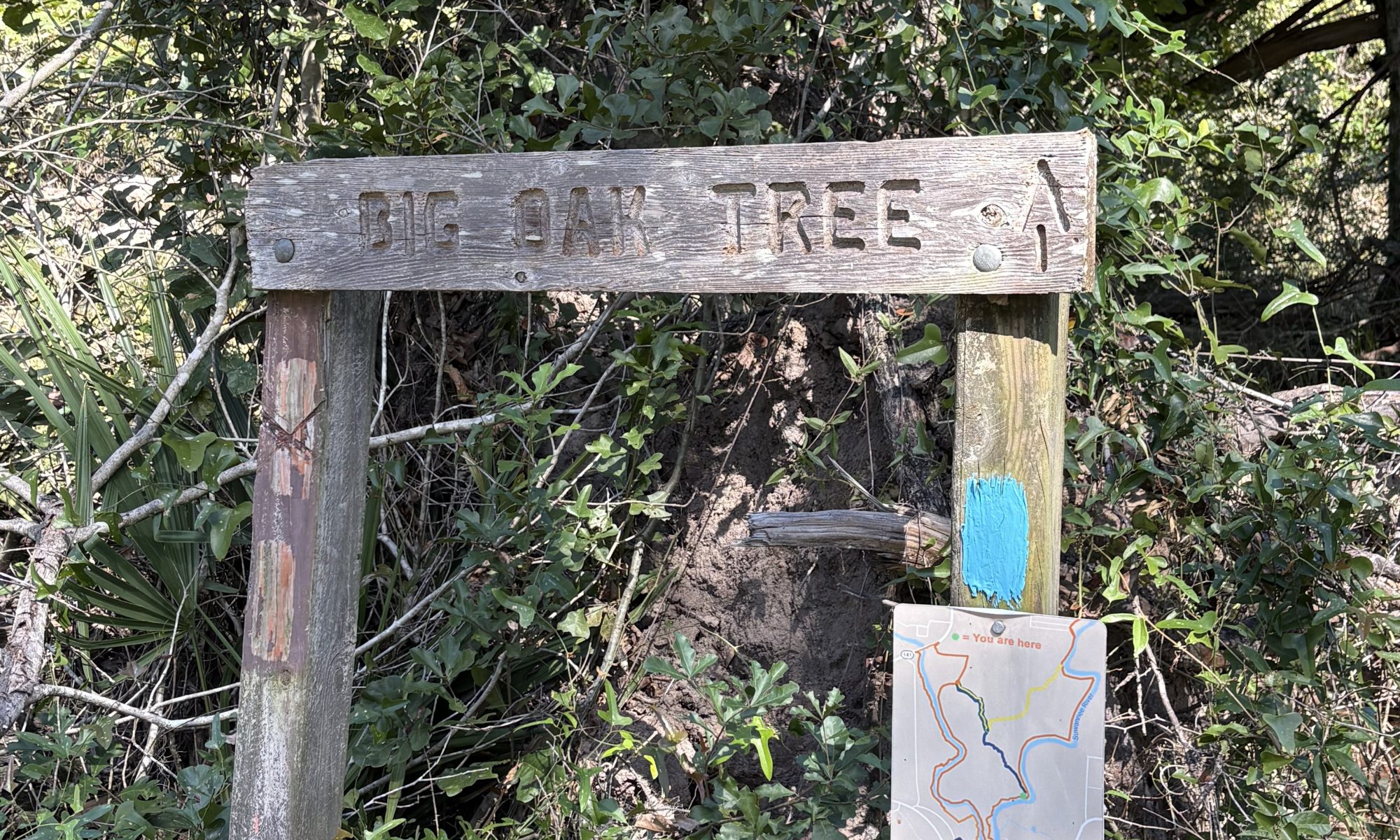
Looking back through the photos later, I found one we had taken where we left the orange-blazed Florida Trail for the blue-blazed trail. The wooden sign plainly said “BIG OAK TREE,” with an arrow pointing toward the woods.

I think the tree may have been right there. I may have spent years wanting to find it, finally reached it, photographed the sign pointing to it, and then walked straight past it.

Which is especially funny because that was also the exact point where the hike began to go off the rails. We should have stopped, found the tree, admired it for a while, and headed back toward the trailhead. Instead, we kept walking.

— Dion, Anasa founder
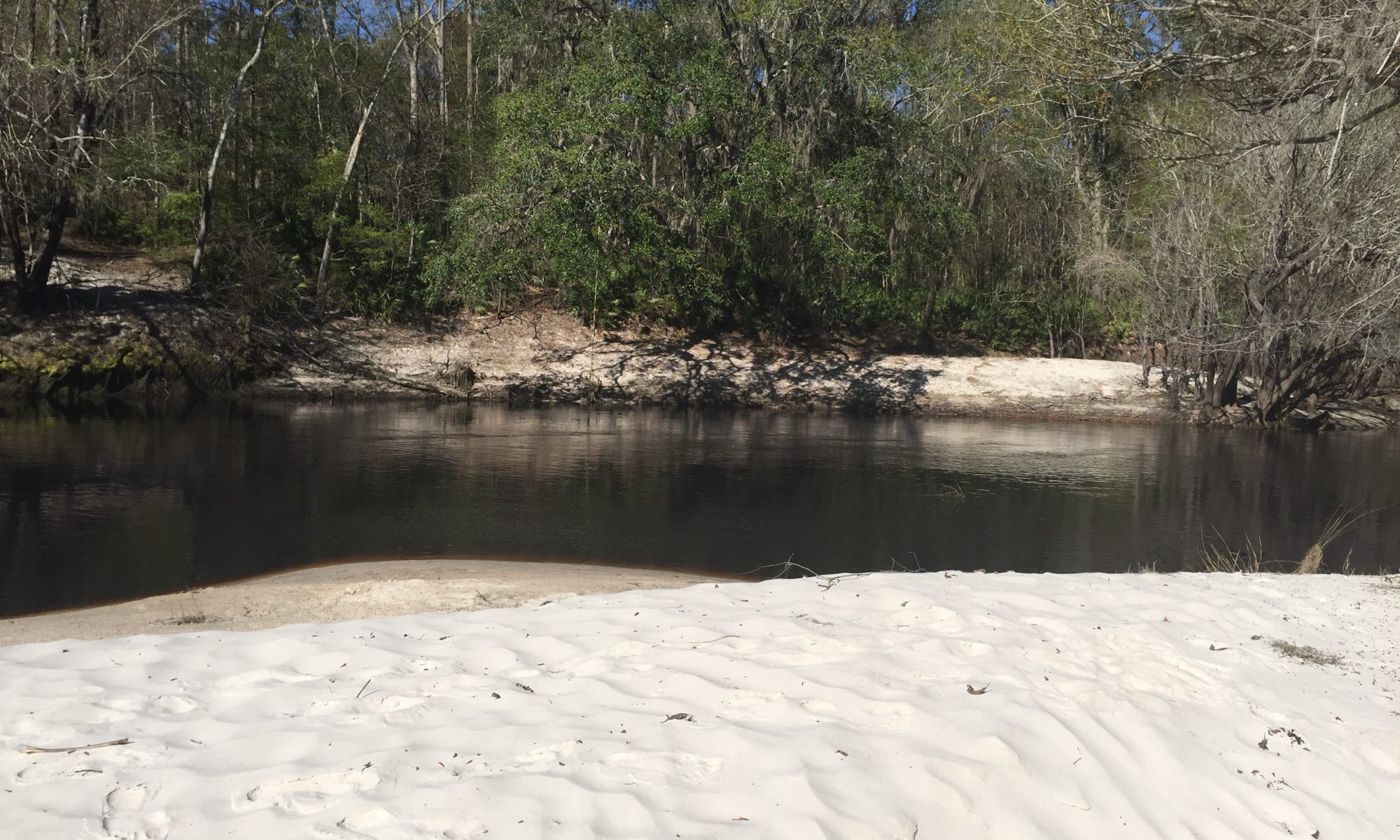
The Song That Made the Suwannee Famous

Upper Suwannee River

Stephen Foster never saw the Suwannee River, which may be the strangest part of this entire story. But for those of us who grew up around the Suwannee, it is a very real place. It is black water beneath limestone bluffs, springs spilling into the river, cypress knees along the banks, sandbars, shoals, ferries, and bridges. But for much of the country, the Suwannee became famous first as a line in a song.

In 1851, Stephen Foster wrote Old Folks at Home, the song many people would come to know simply as “Swanee River.” Foster was living far from Florida, and there is no evidence that he ever visited the river he made famous. The choice of the Suwannee was not the result of some memorable trip south or a personal attachment to this part of Florida. He was looking for a river name that worked in the song, and somehow he landed on the Suwannee. Even the spelling changed. Foster wrote it as “Swanee,” turning a real North Florida river into something that fit the rhythm of his music.

The song became enormously popular. By 1854, more than 130,000 copies had been sold, which was a remarkable number for the period. It spread through sheet music, performances, and eventually recordings, carrying the name of a river most Americans had never seen into homes far beyond Florida.

The Suwannee had existed for thousands of years before Stephen Foster wrote about it, but after 1851 it was no longer just a river. It had become an idea. People who had never visited North Florida knew the name Suwannee. Over time, the river became associated with longing for home, distance, memory, and the South itself. “Way down upon the Swanee River” became familiar even to people who could not have found the Suwannee on a map.

Eventually, Florida claimed the song as its own. In 1935, Old Folks at Home became the official state song, and White Springs eventually became the place where Florida chose to remember its composer.

That part of the story came much later. In 1931, Josiah K. Lilly proposed creating a memorial to Stephen Foster because his song had made the Suwannee River known around the world. The idea eventually led to the Stephen Foster Memorial at White Springs, which opened in 1950 and later became what we know today as Stephen Foster Folk Culture Center State Park.

There is something wonderfully strange about that sequence. A man in Pennsylvania writes a song about a river he never visits. The song becomes famous. The river becomes famous because of the song. Nearly a century later, a town along that river builds a memorial to the man who wrote it.

Growing up here, I never thought much about any of that. The Suwannee was simply the Suwannee. It was somewhere we swam, fished, paddled, crossed, and drove beside. It was part of the landscape rather than something that had first entered the imagination of much of the country through a song.

And yet the song has always been there too. To this day, I sing it almost every time I cross the Suwannee. It does not seem to matter which bridge takes me across. Somewhere between one bank and the other, “Way down upon the Swanee River” usually makes an appearance.

I have probably done that hundreds of times without giving much thought to how strange it really is. A song written in 1851 by a man who never saw this river somehow became part of my own ritual for crossing it.

Only later did I realize that millions of people knew the Suwannee in exactly the opposite order. They knew the song first. For them, the Suwannee may have existed as a lyric long before it became a place. For me, the river came first, and the song simply followed me across it.

That may be what I find most interesting about this story. Names have a strange way of carrying places farther than geography ever could. Stephen Foster never saw the Suwannee River, but the song he wrote in 1851 helped make sure much of the world knew its name. Eventually, the river returned the favor by giving Foster a permanent home on its banks.

Experience It

Stephen Foster Folk Culture Center State Park sits beside the Suwannee River in White Springs, a short drive from Anasa. Walk through the park, listen for the carillon from the tower, visit the museum if it is open, and then make your way down toward the Suwannee itself.

It is worth remembering that the river in front of you is the same one Foster chose from hundreds of miles away without ever seeing it.

If you are staying at Anasa, White Springs makes an easy half-day outing and pairs naturally with the Telford Hotel, the old spring house, and some time beside the river.

After spending the last few Field Notes exploring White Springs, there is still one question I want to come back to someday: Why did this little town become the place where Florida decided to remember Stephen Foster?

— Dion, Anasa founder

The Spring That Built a Town

White Springs is a small town today. It was a small town then, too, at least by any national measure. But for a brief period around the turn of the twentieth century, it became something much larger than its population would suggest. The reason was the spring.

People came to White Springs to drink the mineral water, bathe in it, and seek relief from whatever ailments they believed the water might cure. They came by stagecoach and later by train. They stayed in hotels and boarding houses, ate in restaurants, shopped in town, and spent days or weeks beside the Suwannee.

The spring did not just give White Springs its name. For a time, it gave the town its economy. By 1910, White Springs had at least thirteen hotels and boarding houses. There were shops, entertainment, dining rooms, transportation services, and a growing resort economy built around visitors coming to take the waters. The town had 1,177 residents that year. Today, White Springs has fewer than 800.

That difference does not prove that the spring alone made or unmade the town. White Springs also had lumber, agriculture, railroads, and other industries that shaped its fortunes. Fire, changing travel patterns, highways, and the rise of other Florida destinations all played a part in what happened next.

Still, the numbers hint at just how much activity once revolved around the spring. At the center of it all was the spring house.

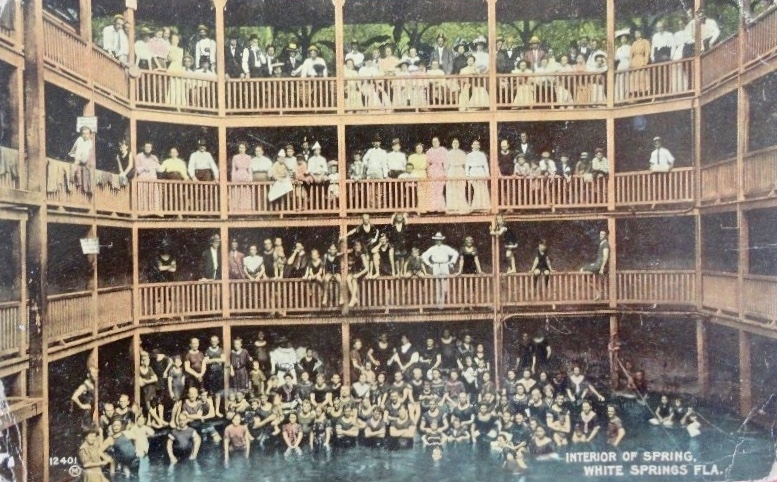
What survives today is a striking shell of what it once was. The old walls still rise beside the Suwannee, enclosing a place that once drew visitors from across the country. Historic photographs show crowds, bathing platforms, and an elaborate structure built around water that flowed with enough force to make the spring itself the centerpiece of town life. And that is where the story becomes harder to ignore. The spring barely flows now.

The first time you see the old spring house, it can be difficult to reconcile the ruins with the stories. You can understand the architecture. You can imagine the hotels. You can picture people arriving by train and walking toward the water. But then you look down. The thing that made all of this possible is barely there.

White Sulphur Spring once discharged large quantities of water from the Floridan aquifer. Over the twentieth century, that flow became weaker and less reliable. By 1977, the spring stopped flowing altogether for the first time on record.

The reasons are more complicated than any single explanation. Spring flow depends on pressure in the aquifer below us. Rainfall matters. Drought matters. So does groundwater pumping. And in White Springs, there is another part of the story just north of town.

The phosphate mine opened in the 1960s, and groundwater associated with its operations has long been pumped from the same regional aquifer system that feeds springs like White Sulphur. Later groundwater modeling found that phosphate pumping had a measurable effect on White Springs, and that removing that pumping in the model allowed spring flow to recover significantly.

That does not mean every gallon pumped by the mine would otherwise have come bubbling out of White Sulphur Spring. Groundwater does not work that neatly. But it does mean the connection is more than speculation.

Part of me wants the answer to be simple. Shut down the mine, let the aquifer recover, and see whether the spring that made White Springs famous could flow again. I would love to see that happen.

But I also grew up in this part of North Florida, and I know the other side of that equation. The phosphate industry has provided generations of jobs across Hamilton, Suwannee, and the surrounding counties. Members of my own family have worked there. So have the families of people I grew up with. For a rural community, those jobs are not an abstraction.

That does not make the loss of the spring less important. It does not mean groundwater impacts should be ignored. It simply means the question cannot honestly be considered in a vacuum. I can wish the spring flowed the way it once did and still understand why the answer is more complicated than simply closing the gates at the mine. That may be the part of White Springs’ story I find most interesting now.

The town was once built around a natural feature powerful enough to shape its economy, its identity, and the way outsiders saw it. The spring house still stands. The spring itself is barely a trickle.

The strangest thing about visiting the old spring house today is that the building outlived the water it was built around. And yet the story is not completely finished. White Springs is still here. So is the spring. The question now is what both of them become next.

Experience It

The old spring house sits beside the Suwannee River in White Springs, a short drive from Anasa and close to Stephen Foster Folk Culture Center State Park.

Walk down to the spring house and spend a little time there before heading toward the river. Look at the walls, the scale of the enclosure, and the old photographs .

Then look at the water that remains. It is one of the clearest places in North Florida to see how dramatically a landscape can change while the structures around it remain.

If you are staying at Anasa, White Springs makes an easy half-day outing and pairs naturally with a walk through Stephen Foster, a stop at the Telford Hotel, or a drive along the Suwannee. This is one of those places where the story becomes easier to understand once you stand inside it.

The Last Hotel Standing

The Telford Hotel

White Springs once had more hotels and boarding houses than you would ever guess from driving through today.

At the height of its resort years, visitors came for the mineral spring, for the promise of health, and for the kind of social life that made this little town on the Suwannee feel much larger than it was. They stayed in hotels, took the waters, walked the town, and gathered around a spring that had become famous well beyond North Florida. Most of those hotels are gone now. The Telford is the one that stayed.

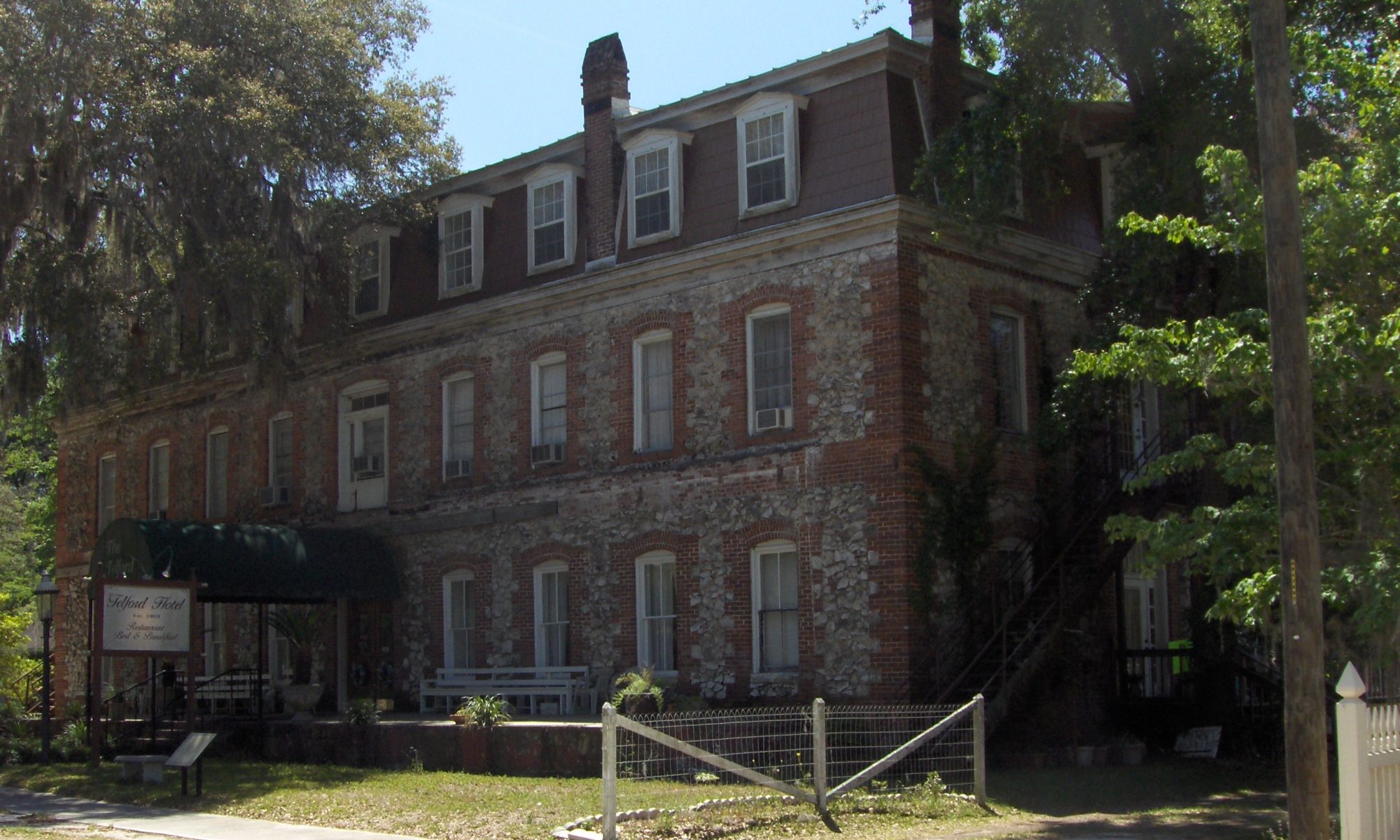
Construction began in 1902, during the height of White Springs’ resort era. The hotel was associated with William Butler Telford, and it stood out because it was built differently. While so much of the town was still wood, the Telford was White Springs’ first masonry hotel, built with red brick framing around pale, irregular stone.

That stonework is one of the things I like most about the building. It has always reminded me of the surviving masonry ruins at Suwannee Springs. There, another resort town had already learned how vulnerable large wooden hotels could be. A huge wooden hotel burned in 1884 and was replaced by a smaller brick-and-stone hotel. That second hotel burned in 1901, just before construction began on the Telford.

I have found no evidence that the two hotels shared a builder, materials, or any direct connection. But they belonged to the same era and the same river country, and both reflect a time when permanence was beginning to matter.

The Telford’s timing was fortunate. In 1911, fire swept through White Springs and destroyed more than thirty buildings, including four hotels, businesses, homes, and the high school. The Telford survived. That alone would have made it unusual, but the building’s real story is not simply that it escaped one fire. It is that people kept finding reasons for it to remain useful.

Over the years, the Telford served not only as a hotel but also as a nursing home, private residence, restaurant, bed-and-breakfast, and even the headquarters of a broadcasting company. Each new use gave the old building another chance to survive while so much of the White Springs resort era disappeared around it.

By 1910, White Springs had at least thirteen hotels and boarding houses. Today, the Telford is the only historic hotel from that boom still standing. That is what makes the building more than just an attractive old structure. It is one of the few places where you can still physically see the White Springs described in old advertisements and newspapers.

There is another reason the name caught my attention. My favorite spring in North Florida is Telford Spring, named for Reverend William Brazelton Telford. My favorite old building in White Springs happens to carry the same last name.

The hotel’s William Butler Telford and Reverend William Brazelton Telford even shared the same first name and middle initial, and both appear to have come from the same broader South Carolina Telford family. They were likely related, although I have not yet been able to document exactly how. For now, it is one of those family-history threads that is visible enough to notice, but not quite clear enough to tie into a neat knot.

The Telford was also part of the same experience that brought people to White Springs in the first place. Visitors came to drink the mineral water, bathe in the spring, seek treatments, and stay in town while they did it. The hotel opened just as White Springs was transforming its spring facilities into the elaborate spring house that would become the town’s centerpiece.

The hotel was where people stayed. The spring was why many of them came. Even some famous names passed through. An old guest register from 1913 includes the names of former presidents Theodore Roosevelt and William Howard Taft, a reminder that White Springs once attracted visitors from far beyond this part of Florida.

That is difficult to picture now, which may be exactly why I like the Telford so much. It gives the imagination something solid to work with. You can stand in front of it and see the stone, the brick, the porches, and the scale of the building and understand that White Springs was once a very different place.

And the story is not entirely finished. White Springs is once again asking what the Telford might become next. I have caught myself wondering the same thing. An old hotel in a historic spring town is exactly the sort of thing I should probably appreciate from a safe financial distance. Still, it is hard not to imagine what a place like this could become with the right kind of care. For more than a century, people have kept finding new reasons for the Telford to survive. I hope they find one more.

Experience It

The Telford Hotel stands in the historic center of White Springs, a short drive from Anasa. It is close to the old spring house, Stephen Foster Folk Culture Center State Park, and the Suwannee River, which makes White Springs an easy half-day outing during a stay.

Walk past the hotel, continue toward the old spring house, and then down toward the river. Try to picture the streets filled with visitors moving between hotels, shops, porches, dining rooms, and the spring itself.

White Springs is one of the easiest places near Anasa to experience the kind of North Florida I keep writing about: a place where the history is still visible if you slow down enough to notice it. The Telford is one of the best places to begin.

Stay nearby, explore slowly.
Anasa is a nature hotel near Live Oak, created for weekends built around places like this.

When White Springs Was Famous

It is difficult to look at White Springs today and imagine what it once was. The town still sits quietly beside the Suwannee River, surrounded by the same North Florida woods that have always defined this part of the state. Drive through today and you might notice the historic buildings, the entrance to Stephen Foster Folk Culture Center State Park, or the old spring house beside the river.

What is harder to imagine are the crowds. There was a time when people traveled to White Springs from across the South specifically to spend their vacations here. They arrived by stagecoach and later by train, checked into hotels and boarding houses, dressed for dinner, attended dances, shopped along the streets and, most importantly, came to drink and bathe in water that they believed could make them well.

Long before Florida tourism meant beaches, theme parks or winter condominiums, people were already coming here. They came for a spring.

The Water That Started It

The sulfur spring beside the Suwannee had been known long before there was a town around it. Local traditions describe Indigenous people regarding the spring as a place of healing, and later settlers inherited the belief that its mineral-rich water possessed medicinal qualities.

By the early 1800s, those claims were spreading well beyond North Florida. The water was promoted as a treatment for ailments ranging from rheumatism and kidney problems to nervous disorders.

It sounds strange through modern ears, but mineral-spring tourism was a serious business in the nineteenth century. People traveled great distances to places where they believed the water could restore their health.

In the 1830s, Bryant Sheffield acquired the spring and ferry crossing and eventually built a hotel and spring house beside the water. What began as a rural spring on the Suwannee was becoming a destination. Florida State Parks describes White Springs as Florida’s first tourist attraction, and a USGS history calls it the state’s first tourist destination.

A Resort Town on the Suwannee

By the late nineteenth century, White Springs looked very different from the quiet town we know today. Visitors first arrived by stagecoach, but the railroad made the town much more accessible. Hotels and boarding houses multiplied as travelers came for the water, the climate and the chance to spend days along the Suwannee.

By the 1880s, visitors could choose from roughly 500 hotel and boarding-house rooms. Later accounts describe a town with luxury hotels, shops, dining, dances, tennis, skating and other entertainment built around the resort trade.

Try to picture that the next time you drive through White Springs. Instead of quiet streets, imagine travelers stepping off trains with luggage. Imagine hotel porches filled with guests escaping the heat of the day. Imagine people strolling toward the spring dressed for an afternoon in a resort town.

At the center of almost everything was the water. The spring eventually became surrounded by an elaborate multi-level bathhouse. Visitors could change clothes, be examined by physicians and descend toward the water from galleries surrounding the spring. The surviving concrete and coquina structure dates to the early twentieth century, although what remains today is only part of what visitors would once have seen.

We will come back to that spring house in another Field Note, because it deserves a story of its own. So does one of the hotels.

The Town the Spring Built

What interests me most about White Springs is how completely one natural feature shaped the town around it. The spring created the destination. The visitors created demand for hotels, restaurants, shops and entertainment. Transportation followed the visitors, and an entire local economy grew around the idea that this particular water was worth traveling to experience.

For a while, White Springs was exactly the kind of place people pictured when they thought about taking a restorative trip to Florida. Then tastes changed. By the 1930s, Americans were losing interest in mineral-spring cures, and the resort culture that had supported White Springs began fading with them. The hotels disappeared one by one, and the crowds that had once filled the town largely stopped coming.

White Springs did not disappear like Columbus or Ellaville. Instead, it became something quieter. That may make the traces of its former life even more interesting, because so much of the old town is still there if you know what you are looking for.

Experience It

The best way to begin exploring this story is simply to walk around White Springs with the resort era in mind. Visit the old spring house beside the Suwannee and imagine it filled with people who had traveled there specifically for the water. Walk through the historic part of town and notice the older homes and buildings that remain from an era when visitors arrived with trunks instead of overnight bags. Then stand for a while beside the river.

It is hard to reconcile the quiet of White Springs today with the town that once welcomed thousands of visitors seeking health, recreation and a few days away from ordinary life.

That contrast is exactly what makes the place worth knowing. Before Florida became famous for beaches, amusement parks and sunshine, one of its first tourist destinations was a small town on the Suwannee River. And it all began with a spring.