Crossing the Suwannee

Every time I cross the Suwannee River, I do the same thing.

It usually starts with the highway signs. If you’ve driven across the Suwannee in Florida, you’ve probably noticed them, the signs with musical notes, a nod to the song that made this river famous.

And almost without fail, I start singing: Way down upon the Suwannee River… I’ve done it for years.

But more recently I found myself wondering something I’d somehow never really thought about: How did people get across before there were bridges?

It occurred to me that I’d crossed the Suwannee hundreds of times. I knew the song. I knew the river. I’d even jumped off one of its bridges.

But I’d never really thought about the crossing itself. 

Once you look at a map, the importance of the Suwannee becomes obvious. The river begins in Georgia and winds south through North Florida before emptying into the Gulf. Travel west across this part of Florida and, sooner or later, you have to cross it. To truly go around it, you’d have to head north into Georgia before coming back down into Florida.

Today, crossing hardly qualifies as an obstacle. We drive across a bridge in less than a minute. But for much of Florida’s history, it was a very different problem. Travelers had to find a crossing. And at Suwannee Springs, you can still see how four generations of Floridians solved it.

The earliest crossing at Suwannee Springs was a ferry. Before bridges connected the two banks, travelers arriving here had to stop and wait to be carried across. Eventually, the ferry was replaced by a bridge. That bridge was replaced by another. And that one eventually gave way to the modern crossing we use today.

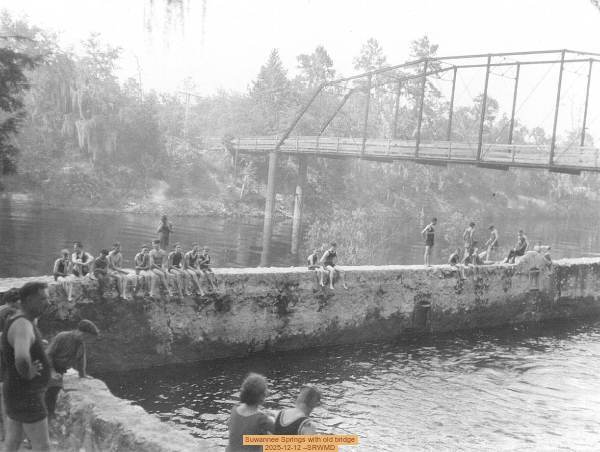
Four generations of crossings, all within the same small stretch of river. Pieces of that history are still there. Near the spring, old rusted piers stand by the river, the remains of the first bridge that once carried travelers from one bank to the other.

Just downstream stands its successor, an old steel truss bridge that no longer carries traffic. Most locals know it simply as the Graffiti Bridge. And I knew that bridge long before I knew its history. When I was a teenager, the Graffiti Bridge was a popular swimming spot. And yes, we jumped off it into the Suwannee. More than once.

I’m certainly not recommending anyone repeat that particular part of the experience today. But whenever someone asks that old parental question, “If your friends jumped off a bridge, would you?” I suppose I have to answer honestly. Yes!

At the time, I wasn’t thinking about the bridge as history. It was simply part of growing up around the Suwannee. I didn’t know that another bridge had stood before it. I certainly wasn’t thinking about the ferry that came before either of them. It was just the river.

And maybe that’s what I find most interesting about these places. Sometimes we can know somewhere our entire lives without really knowing its story.

Think about how differently people have experienced this one spot.

There was a time when a traveler arrived at the Suwannee and had to stop. Was the ferry running? Was the river too high? How long would the crossing take?

Eventually, travelers crossed on a bridge. Years later, teenagers like me jumped from another one into the water below.

Today, most of us pass over the same river on a modern highway without giving the crossing much thought at all. The river is still there. The problem hasn’t changed. Every generation has simply found a different way across.

Experience It

The next time you’re near Suwannee Springs, don’t just cross the river. Stop for a while. Walk down to the spring and look out across the Suwannee. Imagine arriving here before there was a bridge and realizing that your journey couldn’t continue until someone carried you to the other side.

Look for the old bridge piers by the river. Then walk over to the Graffiti Bridge and stand on a crossing that itself became obsolete when the next generation built another one nearby. But please don’t follow my teenage example and jump off it!

Instead, take a few minutes to notice something that’s easy to miss: In one small stretch of the Suwannee, you can see the story of how North Florida learned to cross a river. And when you get back in the car and drive across the newest bridge, maybe do what I do. Sing a few words.

Way down upon the Suwannee River…

Only now, look down. And think about all the people who had to figure out how to get to the other side.

— Dion
Maybe she was paying attention all along

A few days ago, I was walking into a doctor’s appointment when my phone buzzed.

It was my daughter, Kendall. She’s in her first semester at FSU (Go Noles!) and she wanted to share something she workshopped in class.

I’ll admit it, I found myself wiping away tears in the hallway. Not because it was my daughter who wrote it, although I’m certainly a proud dad. But because every now and then someone puts words to something you’ve carried in your heart for a long time, and that’s exactly what she did.

As parents, we spend years hoping we’ve passed along something worthwhile. Kindness. Curiosity. A love of people and places. The ability to notice things others walk past.

Reading her poem, I realized something.

Maybe she was paying attention all along.

She gave me permission to share it, and I’m grateful she did. I hope it resonates with you the way it did with me.

Springs on the Suwannee

by Kendall Sweat

Somewhere

I sit among the bald cypresses and swamp gums

with my feet dipped in the cold, clear water,

anchoring me to the moment,

allowing me to stretch my own roots into the soil.

The water bugs dance past me

gliding like figure skaters across the surface,

whispering to me stay afloat

and trust the unseen.

The sun places a blanket over my soul,

encouraging me to curl up

among the bald cypresses and swamp gums

and let my body rest.

I melt into the land that I lie on:

my limbs become the trees,

my blood transforms to water,

my soul joins the dancing water bugs.

I am distant from civilization,

distant from the screaming cars

and the imposing skyscrapers;

the gray, dead concrete.

Somewhere

I sit among the bald cypresses and swamp gums

and their roots reach out to mine,

announcing where I belong.

The Rivers That Disappear

A few weeks ago, I wrote about the Cody Scarp. Millions of years ago, it was Florida’s coastline. Today, in many places, it’s little more than a subtle change in elevation. If you didn’t know it was there, you could drive across it without ever noticing.

But the more I learn about North Florida, the more I realize just how many of the things I love about this place trace back to that ancient shoreline. The springs. The sinkholes. The caves. Even the rivers.

Most rivers have somewhere to go. They flow into another river. A lake. Eventually, the sea.

But in North Florida, rivers begin doing something unusual when they reach the Cody Scarp. Some disappear.

The Santa Fe River flows normally until it reaches a place called River Sink. There, an entire river vanishes underground. Several miles later, it returns at River Rise and continues on toward the Suwannee.

Farther north, the Alapaha River reaches Dead River Sink. During periods of low water, so much water disappears into the limestone that long stretches of the riverbed can become dry.

The Aucilla River may be stranger still. It disappears underground and returns again and again, as if the river can’t decide whether it belongs above the ground or below it.

But not every river disappears. The Withlacoochee crosses the Cody Scarp too. Instead of vanishing, it becomes a river transformed by springs. Madison Blue Spring pours millions of gallons of groundwater into the river each day, and farther downstream, even more springs join it.

That’s what fascinates me. The Cody Scarp doesn’t make every river behave the same way. It simply changes the rules. Some rivers lose water. Some gain water. Some disappear. Some emerge. All because the limestone beneath them becomes exposed enough for water to move in ways it can’t farther north.

The river that has captured my attention is Little River, which is honestly more creek than river. It’s close to where I grew up. Little River flows quietly through North Florida until it reaches a landscape of sinkholes where the water disappears into the limestone.

What happens after that isn’t entirely understood. Researchers believe some of the water may return at Little River Spring, about ten miles away. Other research shows that water entering the Little River and nearby Stick Sink system contributes to the groundwater feeding Troy Spring, on the opposite side of the Suwannee River.

Think about that for a moment. A river disappears into the ground. Its water travels through limestone beneath forests, farms, roads, and even beneath the Suwannee River itself before returning to the surface.

Years ago, when looking for a home to build Anasa,  I nearly bought land just south of Little River Sink. The property had two sinkholes (or karst windows) where you could look directly into the underground water below.

What caught my attention was where they were. On a map, they appeared almost perfectly aligned between Little River Sink and Little River Spring. I have no idea whether they were actually connected. Maybe it was coincidence. Maybe it wasn’t. But standing beside those openings, it was impossible not to wonder what was happening beneath my feet.

That’s one of the things I love most about North Florida. The landscape doesn’t tell all of its stories on the surface. Sometimes they’re hidden beneath the limestone. Sometimes they’re carried underground by rivers that disappear. Sometimes they’re revealed again where a spring quietly returns them to daylight. You just have to pay attention.

Because the North Florida we see is only half the story. Beneath it is another landscape entirely. One where rivers don’t always follow the blue lines we draw on maps.

— Dion

P.S. Have you ever visited River Sink, Dead River Sink, Madison Blue, Little River, or Troy Spring? I’d love to hear which North Florida places have surprised you the most.

The Railroads That Disappeared

I grew up around the remains of railroads I never really knew were there.

When I was a child, an old steam locomotive sat beside the Luraville Country Store. I knew it had been pulled from the Suwannee River. I knew it was old. But I don’t think I understood just how old it was, or what it represented.

The locomotive was already an antique when it arrived in Suwannee County. Historians believe it was built sometime between 1850 and 1855, making it one of the oldest surviving steam locomotives in the country. It may have pulled passenger cars during its early years, before being sold to the Bache Brothers Lumber Company around 1890 and put to work hauling logs through the forests of North Florida.

Around 1900, its working life ended in the Suwannee River. No one knows for certain exactly how it happened. One story says the locomotive jumped the tracks at a curve and fell into the river. According to local accounts, the locomotive was being moved across the Suwannee by barge to reach timberland in Lafayette County. As it was lowered down the bluff on a temporary track, the restraining lines broke. The locomotive rolled across the barge and disappeared into the river.

It stayed there for 81 years. During periods of low water, people could see parts of the locomotive beneath the surface of the river. It became part of the local landscape and part of the stories people told.

In 1976, a group tried to recover it. They removed the bell, whistle, throttle, and other pieces, but they couldn’t bring up the locomotive.

Somewhere in this history is a story my uncle Larry once told me. Uncle Larry said he had been involved in an attempt to pull the locomotive from the Suwannee with a wrecker. As I remember him telling it, they weren’t successful. I haven’t been able to determine exactly when his attempt took place or whether it was part of one of the documented recovery efforts. But I remember the story.

And on January 19, 1979, James “Buddy” Lancaster finally brought the locomotive back to the surface. Lancaster had grown up seeing the locomotive in the river during periods of low water and dreamed of recovering it.

After 81 years underwater, the old engine was pulled across the river bottom and brought ashore on the Suwannee County side.

Lancaster brought it home to Luraville and displayed it beside the Luraville Country Store, which his family owned and operated.

That’s where I remember seeing it. I was a child then.

I knew the locomotive had come from the river. But I didn’t understand that the rusting engine beside the road had been built before the Civil War, may once have carried passengers, later hauled logs through the forests of North Florida, and spent more years underwater than most people live.

Eventually, the locomotive was sold to Jack Goyke of Jacksonville Crane Company, who donated it to the State of Florida in 1982. It was restored and moved to Tallahassee, where it remains today.

But the locomotive isn’t the only reminder of the railroads that once crossed this part of Florida. Not far from my river property, another one is still standing in the Suwannee. It’s called Drew Bridge.

Today, the bridge is one of the strangest things you’ll see along this stretch of river. On one side, a dirt road comes relatively close. On the other side, there is almost nothing but forest. No highway. No town. No obvious reason for a bridge to be standing there at all.

But more than a century ago, trains crossed the Suwannee here. According to local histories, the swing bridge was purchased in Brazil around 1899, transported to the Suwannee River, and placed into service around the beginning of the twentieth century.

It became part of the Suwannee & San Pedro Railroad, a line that ran from Live Oak through Mayo and eventually toward Perry. The railroad wasn’t simply carrying passengers between towns. It was part of a much larger network built to reach the forests.

Across Florida, logging companies pushed railroads deeper into timber country. The trains carried workers, equipment, and logs. Communities grew along the tracks. Some of those logging railroads eventually helped lay the foundation for larger commercial lines.

At Drew Bridge, the railroad created its own path through the forest. Tracks approached the river. Trains crossed the swing bridge. The railroad continued through what is now thick woods.

Then the railroad disappeared. The tracks were removed. The forest grew back.

Around 1920, Suwannee and Lafayette counties purchased the abandoned bridge with hopes of converting it into a road crossing. That never happened. The roads never came. And the bridge stayed.

I’ve known about the locomotive and Drew Bridge for most of my life. I saw the locomotive beside the Luraville Country Store. My uncle told me about trying to pull it from the river. I’ve passed the old bridge many times by kayak.

But for most of my life, they were separate curiosities. An old locomotive. An abandoned bridge. Stories people told. Only recently have I begun to understand that they are remnants of something much larger.

There was once an extensive network of railroads crossing this part of Florida. Some carried passengers and freight between towns. Others were built deep into the forests to carry away the longleaf pine and cypress that fueled the growth of North Florida.

The locomotives disappeared. The tracks were pulled up. The mills closed. The forest grew back. And within only a few generations, much of that railroad world became almost invisible.

That’s one of the things I find most interesting about North Florida. The landscape doesn’t always tell you what happened there. Sometimes you have to look for what’s left behind.

A locomotive pulled from the bottom of a river. A bridge standing in the middle of the Suwannee. A faint railroad grade disappearing into the forest.

Pieces of a world that once connected towns, carried timber, moved people, and helped shape this part of Florida. The railroad is gone. But if you know where to look, you can still find the tracks it left behind.

— Dion

The Forgotten Resort on the Suwannee

There was a time when people traveled from all over the country to visit Suwannee Springs. Today, most people drive right past it without realizing it’s there.

The springs sit beneath a canopy of oaks along the Suwannee River, tucked away at the end of a quiet road. If you visit today, you’ll find the remains of stone spring walls, a few scattered ruins, and the river flowing much as it always has.

The spring itself is a sulfur spring. You’ll notice the smell almost immediately. It’s not unpleasant once you know what it is, but it’s certainly distinctive. More than a century ago, that mineral-rich water was the attraction. People believed the spring’s waters could help heal a variety of ailments, and they traveled hundreds of miles by train to experience them.

It’s hard to imagine now, but this was once one of Florida’s earliest tourist destinations. Over the years, grand resort hotels were built here to serve visitors who came seeking the mineral waters flowing from the springs. One after another, those resorts were destroyed by fire, leaving behind little evidence of what once stood here. The grounds are quiet. The river moves slowly past the springs. The oaks cast shade over ruins that many people never notice.

For most of my life, I didn’t think much about any of that. To me, Suwannee Springs was a place to swim. My favorite place to jump was from the far spring wall. To get there, I would walk along the top of the old spring structure, all the way around to the opposite wall. The jump felt a little higher there. The water felt a little deeper. Whether it actually was or not didn’t matter much. To me, it was the best place to jump.

I spent years visiting the springs without giving much thought to the people who came before me. Now when I stand there, I find myself looking at those same walls differently.

The wall I once jumped from was built during a time when visitors traveled hundreds of miles to experience these springs. And it’s strange to think that a place many Floridians have never heard of was once known well beyond North Florida.

I’ve always been fascinated by places like that. Not because of what they are today, but because of what they used to be. You can stand beside the spring walls and try to picture the people who once gathered there. Families arriving after long journeys. Visitors hoping the spring waters would improve their health. Guests walking the grounds of hotels that no longer exist. A bustling destination where today there is mostly quiet. What I find most interesting is how little remains.

Many of Florida’s historic attractions were replaced, redeveloped, or built over.

Suwannee Springs feels different. Nature has slowly reclaimed much of it. The river still flows past the springs. The oaks still shade the grounds. And if you look closely, you can still find traces of the people who believed this place was worth traveling hundreds of miles by train to see.

That’s one of the things I love about North Florida. It holds onto its stories. Not always in museums or history books. Sometimes they’re tucked away beside a river, waiting for someone curious enough to stop and look.

— Dion

P.S. Have you ever visited Suwannee Springs? I’d love to hear what you remember about it.