White Springs once had more hotels and boarding houses than you would ever guess from driving through today.
At the height of its resort years, visitors came for the mineral spring, for the promise of health, and for the kind of social life that made this little town on the Suwannee feel much larger than it was. They stayed in hotels, took the waters, walked the town, and gathered around a spring that had become famous well beyond North Florida. Most of those hotels are gone now. The Telford is the one that stayed.
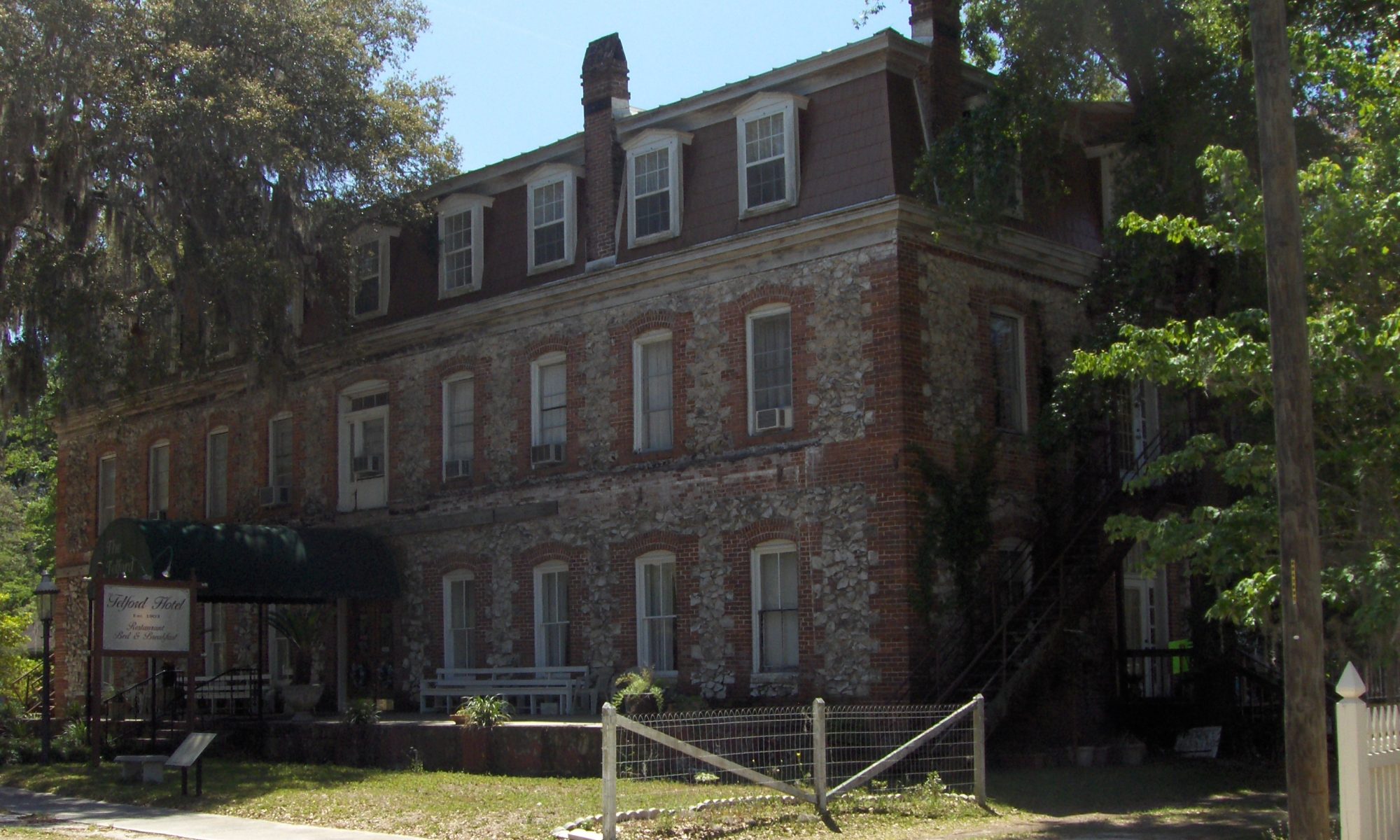
Construction began in 1902, during the height of White Springs’ resort era. The hotel was associated with William Butler Telford, and it stood out because it was built differently. While so much of the town was still wood, the Telford was White Springs’ first masonry hotel, built with red brick framing around pale, irregular stone.
That stonework is one of the things I like most about the building. It has always reminded me of the surviving masonry ruins at Suwannee Springs. There, another resort town had already learned how vulnerable large wooden hotels could be. A huge wooden hotel burned in 1884 and was replaced by a smaller brick-and-stone hotel. That second hotel burned in 1901, just before construction began on the Telford.
I have found no evidence that the two hotels shared a builder, materials, or any direct connection. But they belonged to the same era and the same river country, and both reflect a time when permanence was beginning to matter.
The Telford’s timing was fortunate. In 1911, fire swept through White Springs and destroyed more than thirty buildings, including four hotels, businesses, homes, and the high school. The Telford survived. That alone would have made it unusual, but the building’s real story is not simply that it escaped one fire. It is that people kept finding reasons for it to remain useful.
Over the years, the Telford served not only as a hotel but also as a nursing home, private residence, restaurant, bed-and-breakfast, and even the headquarters of a broadcasting company. Each new use gave the old building another chance to survive while so much of the White Springs resort era disappeared around it.
By 1910, White Springs had at least thirteen hotels and boarding houses. Today, the Telford is the only historic hotel from that boom still standing. That is what makes the building more than just an attractive old structure. It is one of the few places where you can still physically see the White Springs described in old advertisements and newspapers.
There is another reason the name caught my attention. My favorite spring in North Florida is Telford Spring, named for Reverend William Brazelton Telford. My favorite old building in White Springs happens to carry the same last name.
The hotel’s William Butler Telford and Reverend William Brazelton Telford even shared the same first name and middle initial, and both appear to have come from the same broader South Carolina Telford family. They were likely related, although I have not yet been able to document exactly how. For now, it is one of those family-history threads that is visible enough to notice, but not quite clear enough to tie into a neat knot.
The Telford was also part of the same experience that brought people to White Springs in the first place. Visitors came to drink the mineral water, bathe in the spring, seek treatments, and stay in town while they did it. The hotel opened just as White Springs was transforming its spring facilities into the elaborate spring house that would become the town’s centerpiece.
The hotel was where people stayed. The spring was why many of them came. Even some famous names passed through. An old guest register from 1913 includes the names of former presidents Theodore Roosevelt and William Howard Taft, a reminder that White Springs once attracted visitors from far beyond this part of Florida.
That is difficult to picture now, which may be exactly why I like the Telford so much. It gives the imagination something solid to work with. You can stand in front of it and see the stone, the brick, the porches, and the scale of the building and understand that White Springs was once a very different place.
And the story is not entirely finished. White Springs is once again asking what the Telford might become next. I have caught myself wondering the same thing. An old hotel in a historic spring town is exactly the sort of thing I should probably appreciate from a safe financial distance. Still, it is hard not to imagine what a place like this could become with the right kind of care. For more than a century, people have kept finding new reasons for the Telford to survive. I hope they find one more.
Experience It
The Telford Hotel stands in the historic center of White Springs, a short drive from Anasa. It is close to the old spring house, Stephen Foster Folk Culture Center State Park, and the Suwannee River, which makes White Springs an easy half-day outing during a stay.
Walk past the hotel, continue toward the old spring house, and then down toward the river. Try to picture the streets filled with visitors moving between hotels, shops, porches, dining rooms, and the spring itself.
White Springs is one of the easiest places near Anasa to experience the kind of North Florida I keep writing about: a place where the history is still visible if you slow down enough to notice it. The Telford is one of the best places to begin.
Stay nearby, explore slowly.
Anasa is a nature hotel near Live Oak, created for weekends built around places like this.