If you live in or near a city, you can go a long time without really seeing the night sky.
There are always lights somewhere. Streetlights line the roads, houses glow through the trees, parking lots stay illuminated long after dark, and the city itself throws enough light into the sky that many of the stars simply disappear from view.
Drive far enough into rural North Florida, though, and the night begins to look different.
Once the last light fades behind the trees and you get away from the glow of town, your eyes slowly begin to adjust. At first, you notice a few stars. Then a few more. Give it enough time, and the sky seems to keep filling in.
That experience always reminds me that darkness has become something many of us have to intentionally seek out.
For most of human history, a clear night meant looking up at thousands of stars. People used them to navigate, mark the seasons, tell stories, and make sense of the world around them. Today, many of us live beneath skies brightened by artificial light, and we rarely stop to think about how much has disappeared above us.
Of course, nothing has actually disappeared. We have simply made it harder to see.
A Different North Florida After Dark
We spend a lot of time talking about North Florida’s water, and for good reason. The springs and rivers are some of the most remarkable parts of this landscape.
But there is another side of North Florida that does not reveal itself until after sunset.
Once you get away from the larger towns and highways, there are still places where darkness feels like darkness. On a clear night, the number of stars can be startling if you are accustomed to a city sky. Under the right conditions, you may even be able to make out the hazy band of the Milky Way stretching overhead.
The experience is not only visual. The woods sound different after dark. Frogs and insects replace the daytime birds, an owl may call somewhere beyond the trees, and the breeze seems easier to notice when everything else settles down.
A place that felt familiar an hour earlier can feel completely different once the sun disappears.
There is something about sitting outside in that darkness that makes it easier to slow down. You can talk, listen to the fire, watch the sky, or simply sit quietly for a while without feeling like you need to move on to the next thing.
Sometimes that is enough.
Experience It
You do not need much to experience a dark North Florida sky. In fact, the less you bring with you, the better.
Find somewhere away from city lights on a clear night and give your eyes time to adjust. Put your phone away for a while, or at least turn the screen down. If you need a flashlight, use it sparingly. After twenty or thirty minutes in the darkness, you will begin noticing stars that were invisible when you first stepped outside.
You do not necessarily need to know what you are looking at, either. There are apps that can identify planets and constellations, and they can be useful, but sometimes I think we are too quick to turn every experience into something we need to understand or accomplish.
Sometimes it is enough simply to look up.
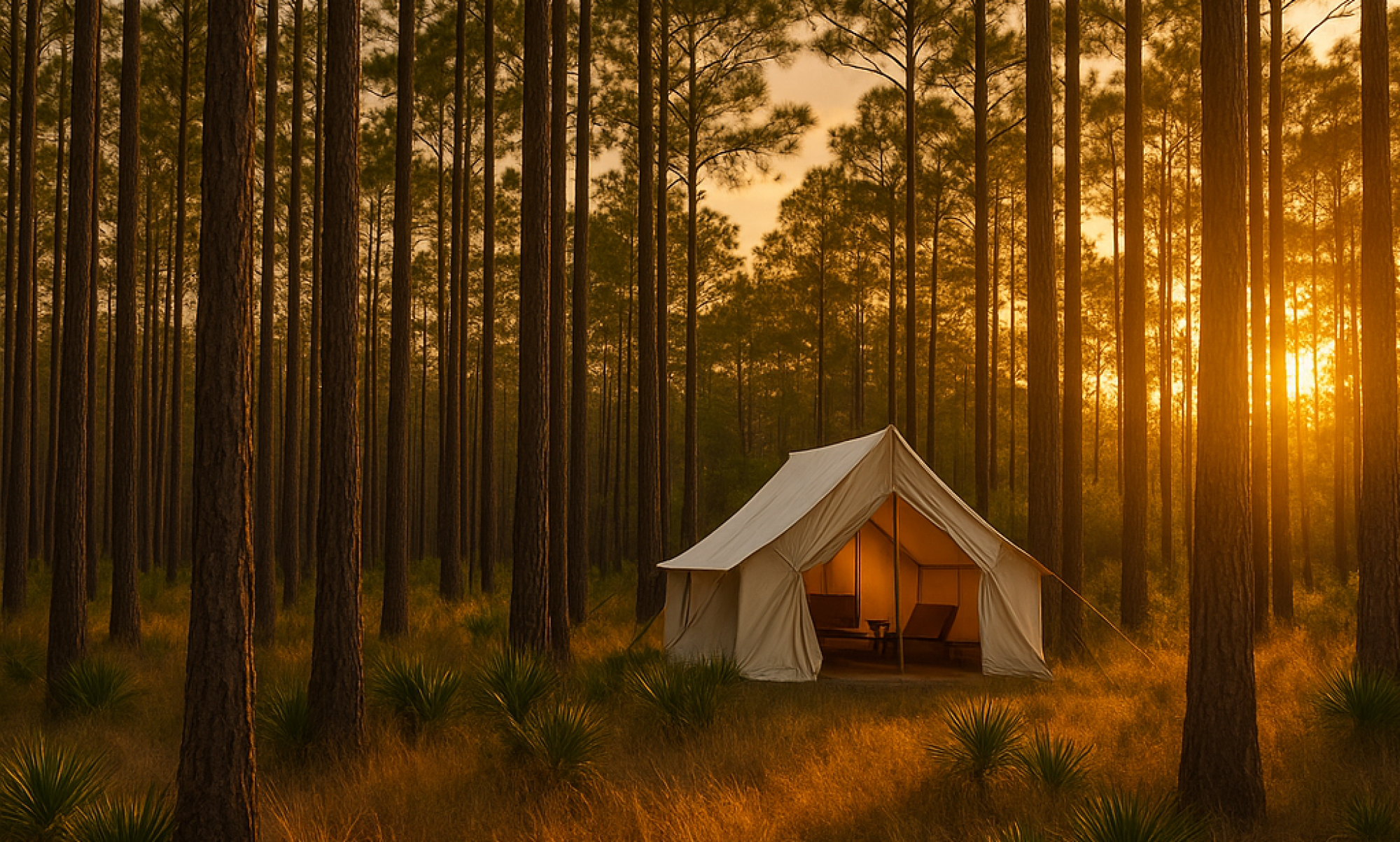
If you are near the Suwannee, spend some time beside the river after dark. If you are camping, let the fire burn down and see what begins to appear above you. If you are somewhere quiet enough to hear frogs, insects, and wind instead of traffic, stay outside a little longer than you normally would.
North Florida gives us plenty of reasons to explore during the day, but some of its best moments happen after we normally would have gone inside.
The stars have been there all along. Sometimes we just need to get somewhere dark enough to see them.
— Dion, Anasa founder